Last reviewed October 2026
Heat is the single biggest variable on a summer slab in the Las Vegas Valley. This page is about pouring concrete in hot weather in Las Vegas: when it is hard, why, and what good practice looks like. It does not promise a pour time or a curing schedule, because those are the contractor's call on the day. If you want to know when you can walk, park or set a hot tub on the finished slab, that is a different question, answered in the concrete curing time guide.
How hot Las Vegas gets, in numbers
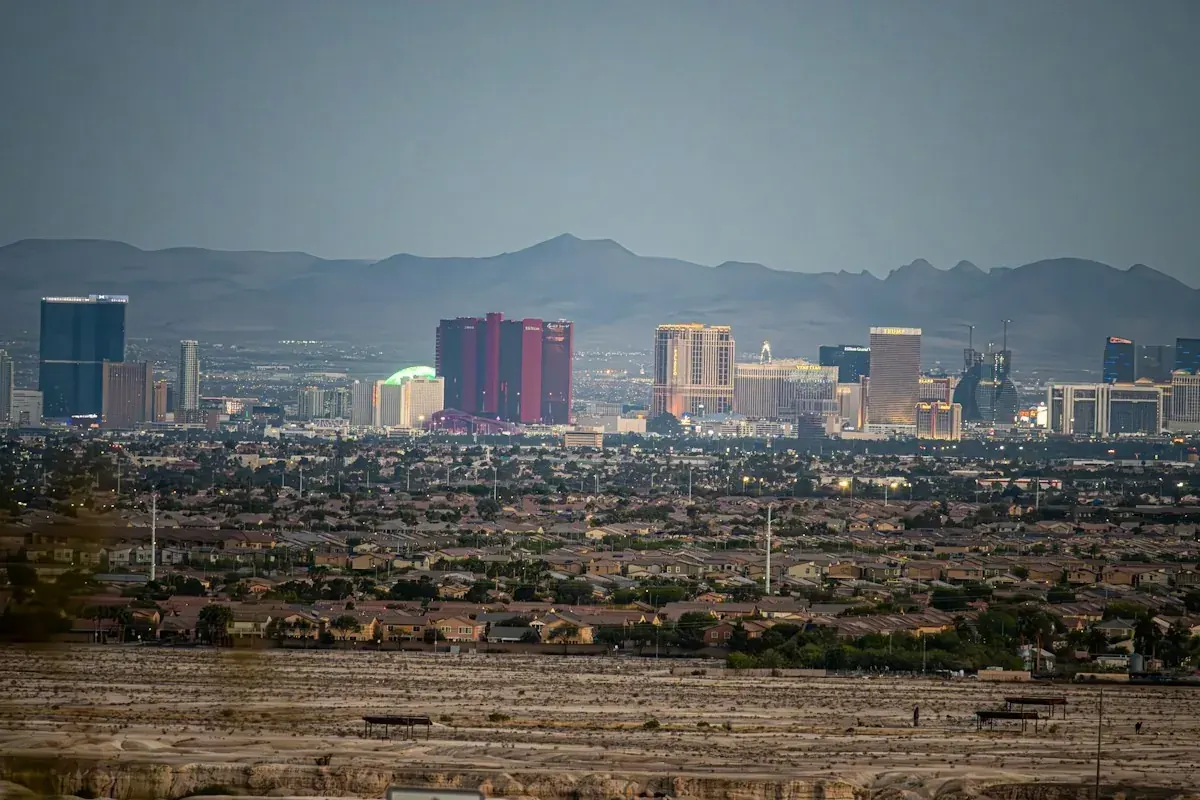
The short answer: past 100F on most summer days. The National Weather Service keeps the official record at Harry Reid International Airport, about 7 miles south of downtown. On the 1991 to 2020 normals, the airport averages 78.2 days a year at or above 100F, 40.5 days at or above 105F and 9.4 days at or above 110F. The hottest reading on the books is 120F on July 7, 2024, followed by 119F on July 9, 2024.
Rain is rarely the issue. The airport's normal annual total is 4.18 inches, and NWS calls Las Vegas the driest major metropolitan area in the continental United States. The exception is the summer monsoon: in July and August a push of moisture brings higher humidity and scattered thunderstorms whose main impact is heavy rain and flash flooding. July through September together normally bring about 1.02 inches, roughly a quarter of the year's rain.
| Month | Normal high | Days at or above 100F | Pour outlook |
|---|---|---|---|
| May | n/a | 2.8 | Mostly workable; a few 100F days |
| June | 99.4F | 17.1 | Hot-weather precautions most days |
| July | 104.5F | 25.8 | Hottest month; monsoon storms possible |
| August | 102.8F | 24.5 | Very hot; monsoon storms possible |
| September | 94.9F | 7.9 | Easing; monsoon typically wanes |
| October | n/a | 0.1 | Rarely 100F |
Swipe the table sideways to see every column →
n/a = no normal high in the NWS figures used here. Sources: NWS Las Vegas Temperature Overview and Number of Days at Las Vegas (1991-2020 normals, Harry Reid International Airport); NWS Climate of Las Vegas for the monsoon notes. The outlook column is our reading of those figures, not an NWS forecast.
Two local details matter. First, the airport is not the whole valley: NWS notes the airport often runs 5 to 15 degrees warmer at night than outlying parts of the valley, so a predawn start in Summerlin or Centennial Hills may begin cooler than the official low suggests. Second, a normal July high of 104.5F is already above the 95F limit ACI sets for the concrete itself, which is why summer pours are planned around the clock, not just the calendar.
What heat does to fresh concrete
Heat makes concrete set sooner, need more water and lose surface moisture faster. Those three effects are what crews are managing on a summer slab.
ACI 305R, the industry guide to hot weather concreting, defines hot weather as any mix of high air temperature, high concrete temperature, low relative humidity, high wind and solar radiation that speeds up moisture loss and cement hydration. NRMCA's summary of it points out that these conditions can occur at any time of year in arid climates, not only in summer. In the Las Vegas Valley, dry air and wind mean a spring or fall pour can call for hot-weather precautions too.
It sets faster
At higher temperatures concrete sets sooner, so finishing has to happen faster. That shrinks the window for screeding, floating and edging, and it is why summer slabs depend on having enough people on site when the truck arrives. NRMCA's guidance stresses scheduling deliveries so trucks can discharge immediately and having adequate personnel to place and handle the concrete.
It wants more water, which weakens it
High concrete temperature increases water demand. If that demand is met by adding water on site, the water-to-cement ratio rises and the concrete ends up with lower strength and reduced durability. NRMCA's rule is to limit added water to what the mix design allows and to avoid adding water to concrete that is more than 1.5 hours old.
The surface can crack before the slab sets
Plastic shrinkage cracks form when the surface dries before the concrete has set. NRMCA describes them as usually parallel cracks about 1 to 3 feet apart that do not reach the slab edge, and lists wind over 5 mph, low humidity and high air or concrete temperatures as the conditions that raise the risk. That combination is an ordinary day in the valley for much of the year. The concrete slab cracks guide covers how to tell this kind of crack from others.
Hot today, cool tonight
NRMCA also warns that thermal cracking can follow a rapid temperature change, such as a slab placed on a hot day followed by a cool night. Desert evenings can drop fast, especially away from the airport, so this is a real consideration in spring and fall as well as summer.
Faster early strength, lower later strength
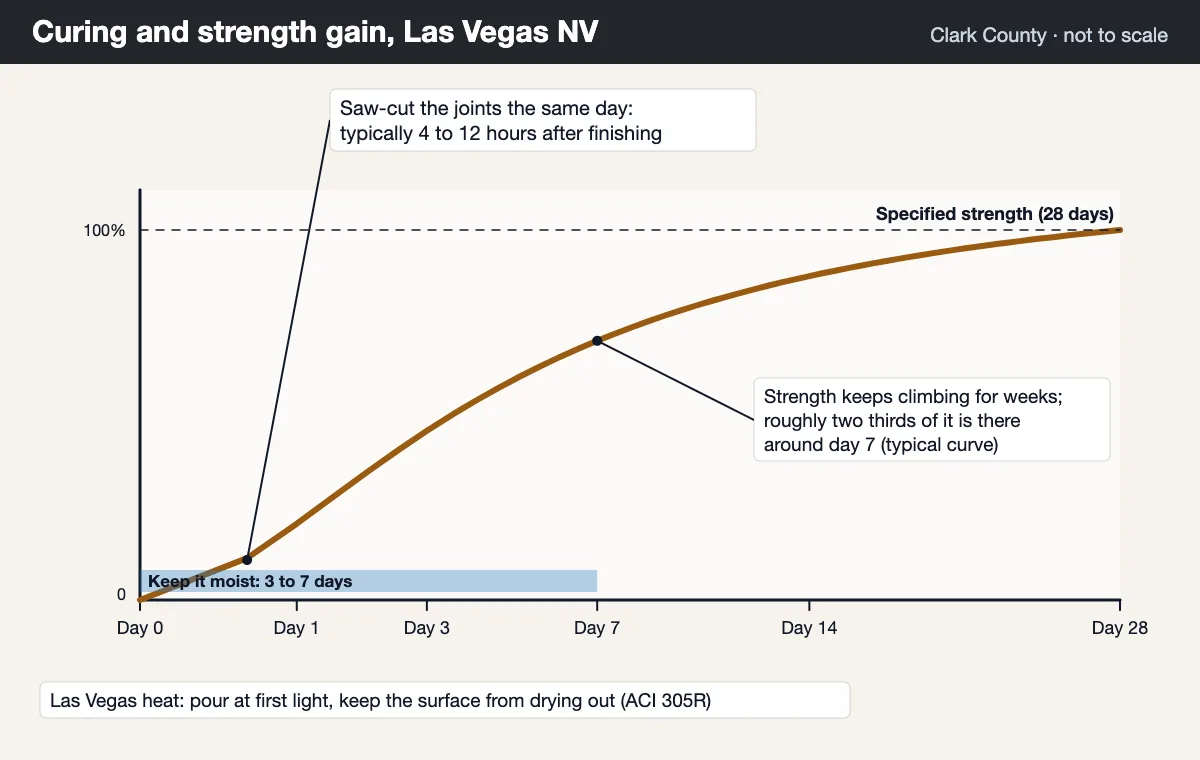
ACI's curing guidance says that as curing temperature rises, concrete shows higher early strength but lower strength at later ages, and that the rapid stiffening and early strength gain at higher temperatures are detrimental to later strength. NRMCA puts it plainly: concrete cured at high temperatures early on will not be as strong later as the same concrete cured around 70F.
The 95F rule: ACI's limit on concrete temperature
ACI 301-20, Specifications for Concrete Construction, and ACI 305.1-14, Specification for Hot Weather Concreting, limit the maximum concrete temperature to 95F (35C) at the time of discharge. That is the temperature of the concrete coming out of the chute, not the air. A mix that runs hotter than 95F has to be backed by successful past field experience or preconstruction testing, and the request must go to the architect or engineer before placement.
For a homeowner's patio or shed slab there is usually no engineer in the loop, and whether a project spec invokes ACI 301 at all is between you and the contractor. Still, the 95F figure is a useful yardstick: it is the industry's own line for when concrete is too hot, and on a typical July afternoon the air alone is nearly 10 degrees past it.
How crews commonly handle a summer pour
The goal is to keep the concrete cool, place and finish it without delays, and stop the surface from drying out. The measures below come from NRMCA's hot weather and plastic shrinkage guidance. They are common practice, not a code checklist, and a contractor will pick what fits the job.
Before the truck arrives
- Schedule around the heat: NRMCA says to avoid the hottest part of the day, and that early morning placement gives better control of concrete temperature in very hot conditions.
- The mix itself: water reducers, set retarders, fly ash or slag cement are all listed as ways to manage slump loss, setting time and heat.
- Chilled water or ice in the mix: NRMCA says chilled water can lower concrete temperature by up to 10F and ice by up to 20F.
- Dampen the subgrade, forms and rebar on hot or dry days, without leaving standing water.
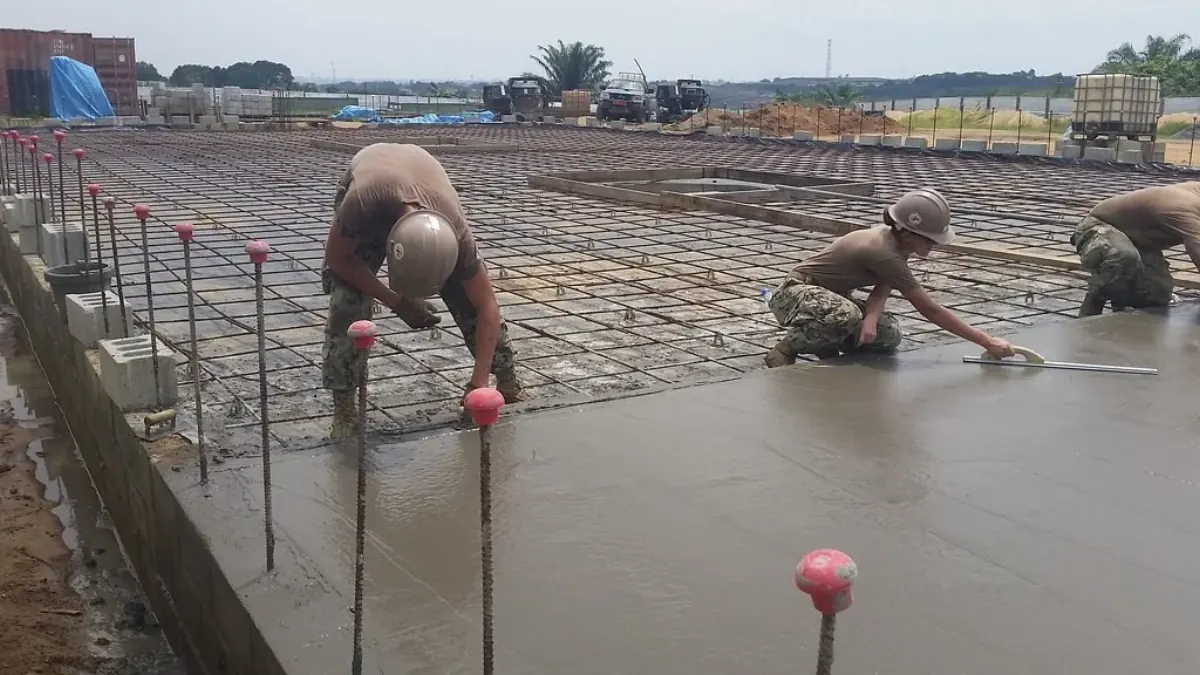
- Have enough hands and tools on site so the slab can be placed and finished promptly once the truck discharges.
- Plan for wind: windbreaks and sunshades reduce evaporation over the surface.
During placing and finishing
- No sprinkling water on the surface to help finishing. NRMCA lists this as a do-not.
- Fog sprays upwind of the slab or an evaporation retarder sprayed behind the screed to slow surface drying.
- Cover between finishing steps with wet burlap or plastic sheeting if delays happen.
- Begin final finishing as soon as the water sheen leaves the surface.
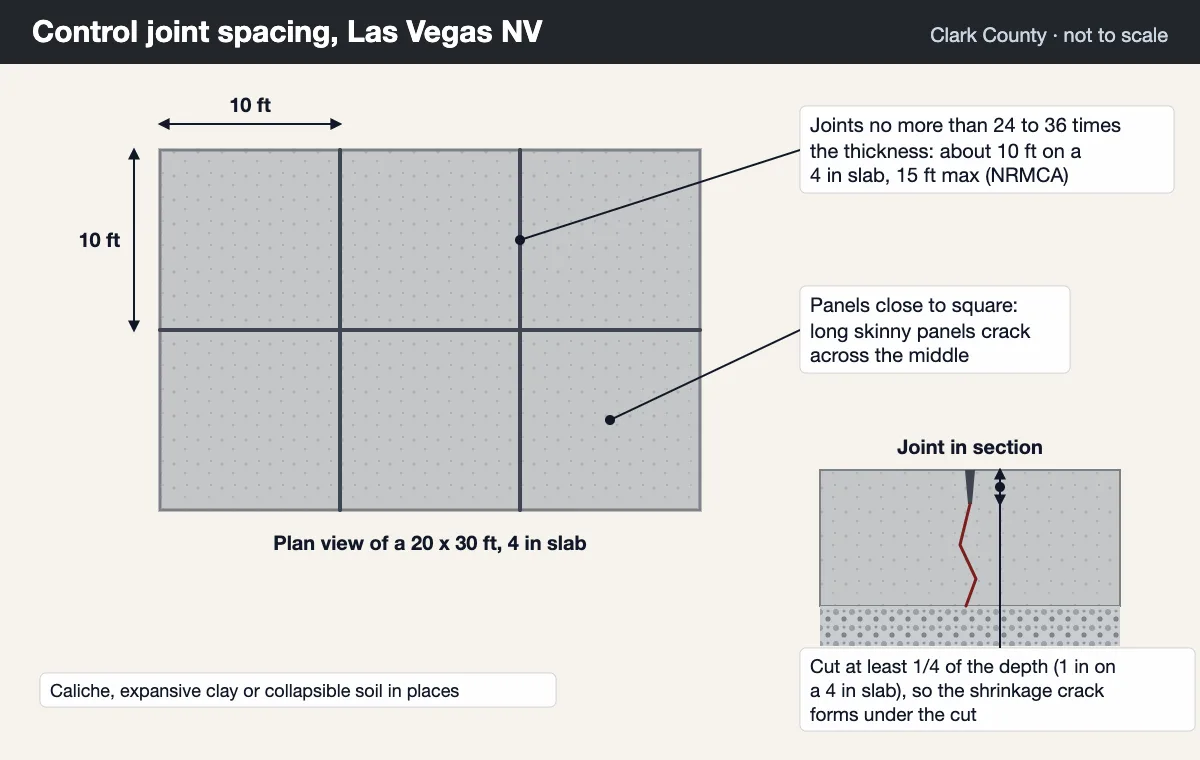
- Cut control joints on time. ACI's FAQ cites guidance that in hot weather saw cuts may need to go in within about 1 hour, against a typical 4 to 12 hours in normal conditions.
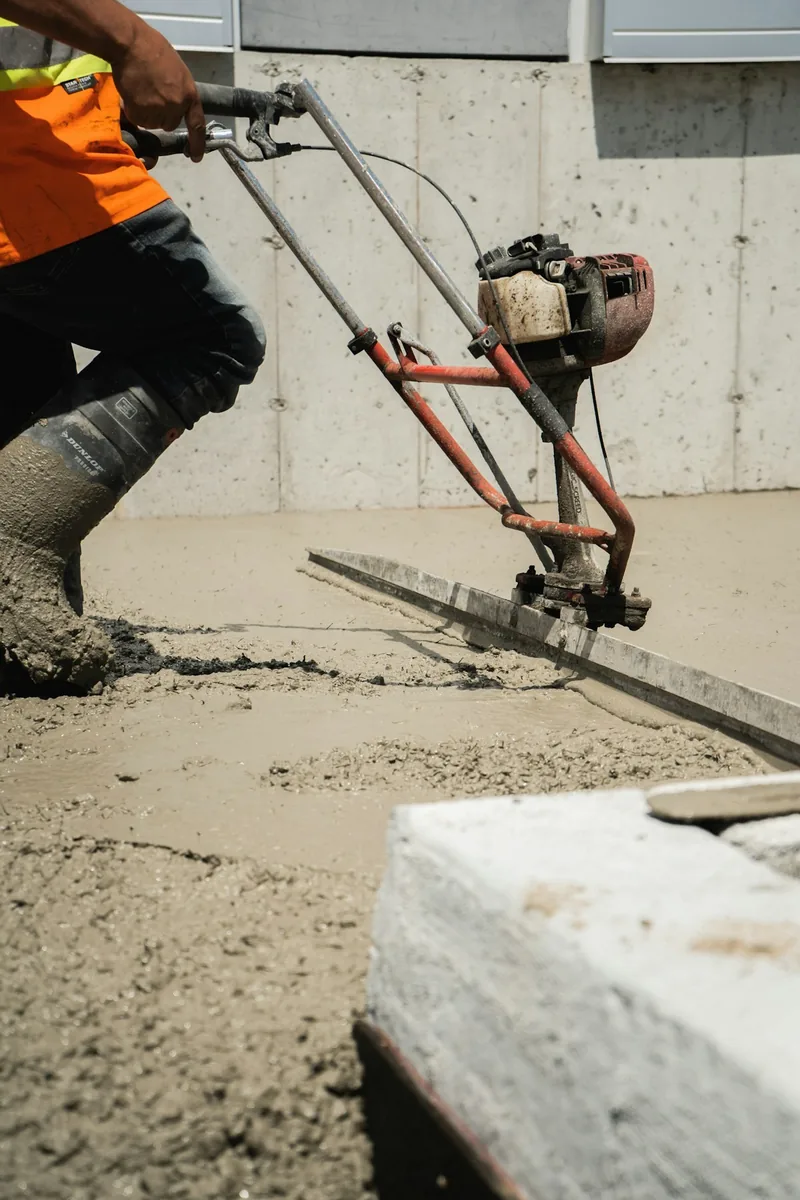
Right after finishing
Curing starts as soon as finishing is done. NRMCA's hot-weather rules call for continuing curing for at least 3 days, with wet burlap and plastic sheeting, a liquid membrane curing compound, or water curing. It adds that a white pigmented curing compound helps show coverage and reflects heat from the surface, and its curing guidance recommends reflective (white) plastic sheets in warm weather rather than clear or black ones.
ACI notes one more hot-weather catch: if water curing leads to a high evaporation rate, cracking can occur from evaporative cooling, and a plastic cover sheet can reduce evaporation.
Is spring or fall a better time to pour in Las Vegas?
On the numbers, the shoulder months are gentler. May averages 2.8 days at or above 100F and October 0.1, against 25.8 in July. That does not make summer off limits, and spring is not automatically easy: dry air and wind can create hot-weather conditions for fresh concrete in any month. Winter has its own limit. The airport averages about 10 nights a year at or below freezing (9.8 on the normals), mostly in December and January, and outlying parts of the valley run colder.
If timing is flexible, it is reasonable to ask a contractor whether they would rather pour your slab in a shoulder month. If it is not, ask how they handle summer work using the checklist below.
Questions to ask before a summer slab
You do not need to manage the pour, but these questions show whether a contractor has a plan for the heat.
- What time do you plan to start placing concrete, and why?
- Will the mix have a retarder, water reducer, fly ash or chilled water for this weather?
- How will you keep the surface from drying out before it sets: fog, evaporation retarder, windbreaks, covers?
- How will you cure it, and for how long? (NRMCA's hot-weather minimum is 3 days.)
- When will the control joints be cut, and how far apart? (See the cracks guide for NRMCA's spacing rule.)
- What happens if the forecast shows a monsoon storm or high wind that day?
Heat and the rest of your slab project
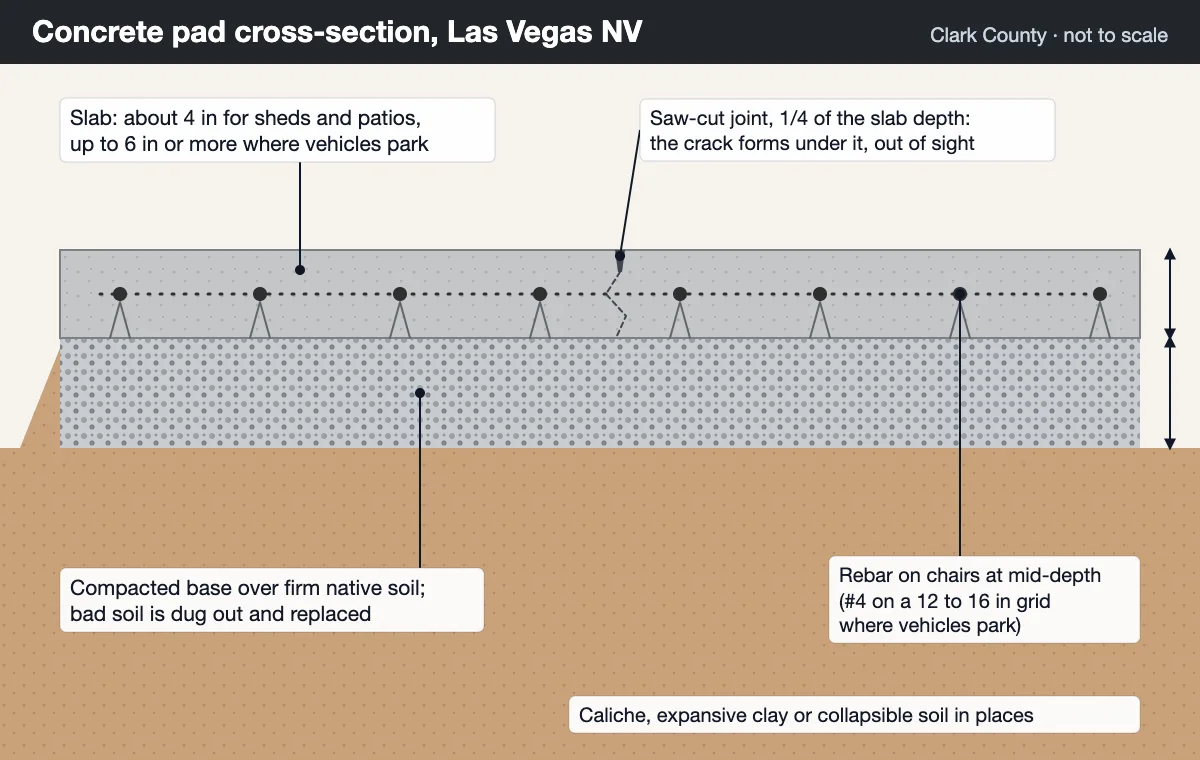
Heat is one part of a good slab in this valley. The ground is the other. Much of the valley has caliche, a lime-cemented hardpan that the caliche guide explains, and some areas have expansive or collapsible soils. Thickness depends on what the slab will carry, covered in the slab thickness guide, and prices are in the Las Vegas concrete slab cost guide.
Common summer jobs include a patio slab for shade-season living, a new AC pad when a condenser is replaced, and a concrete RV pad before fall travel. Check the service area or send a quote request.