Last reviewed October 2026
How long does concrete take to cure? The working answer is 3 to 7 days of curing, then weeks of continued strength gain, with 28 days as the usual benchmark. This guide is about when a new slab can be used. If your question is how heat affects the pour itself, see pouring concrete in Las Vegas heat. Nothing here is a promise about your slab: the contractor knows the mix, the thickness and the weather on the day, and their instructions come first.
Setting, curing and drying are three different things
Most confusion about curing time comes from mixing these up.
Setting
Setting is concrete stiffening from a workable mix into a solid. It happens within hours, faster in heat. A set slab can look finished long before it has much strength.
Curing
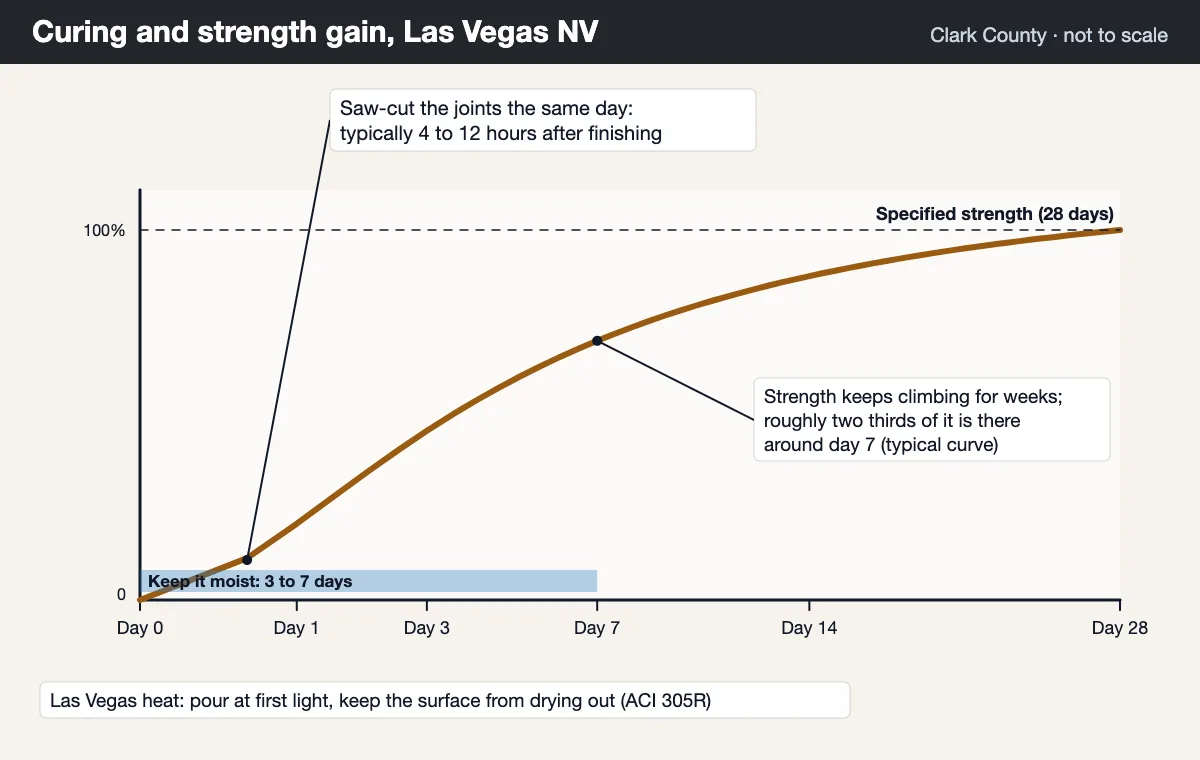
Curing is something done to the concrete, not something it does by itself. ACI defines it as action taken to maintain moisture and temperature conditions in fresh concrete so cement hydration can continue and the mix can develop its potential properties. ACI says the reactions need relative humidity above 80% inside the concrete and temperatures above 50F. NRMCA says curing begins immediately after placement and finishing and should continue for a sufficient period, typically 3 to 7 days.
Drying
Drying is water leaving the concrete. It is not the same as getting stronger. ACI is blunt about this: concrete cannot gain strength except through continued hydration, which can take place only in the presence of water. A slab that dries out early stops gaining strength sooner.
Concrete curing timeline: what the sources say
The table pulls the time figures we could source into one view. Each row names its source, and two of them are consumer cost guides rather than technical bodies, so read those as rules of thumb.
| When | What the source says | Source |
|---|---|---|
| Right after finishing | Curing begins immediately after placement and finishing | NRMCA CIP 11 |
| About 2 days | Protect from freezing until 500 psi, about two days after placement (cold-weather context) | NRMCA CIP 27 |
| About 48 hours | Slab should be walkable | HomeBlue Las Vegas cost guide (Sep 2024) |
| 3 days minimum | Continue curing at least 3 days in hot weather | NRMCA CIP 12 |
| 3 to 7 days | Typical curing period, or as the specification requires | NRMCA CIP 11 |
| About 1 week | Concrete driveway requires a 1-week curing period | HomeGuide driveway pavers guide (Jan 2026) |
| 28 days | Age at which strength requirements are set in most cases | NRMCA CIP 35 |
| 28 to 30 days | Full cure | HomeBlue Las Vegas cost guide (Sep 2024) |
| Months | Can keep gaining strength for a long period if moisture and temperature allow | ACI FAQ on curing and strength |
Sources: NRMCA Concrete in Practice 11, 12, 27 and 35; ACI technical FAQs; HomeBlue, Las Vegas NV concrete slab cost (September 27, 2024); HomeGuide, driveway pavers cost (January 6, 2026). No source here gives an official day for driving or for setting heavy loads.
When can you use a new slab?
Each use puts a different load on the concrete, so the honest answer changes with the job. Here is what can be said from the sources, and what to ask.
Walking on it
HomeBlue's Las Vegas guide says a slab should be walkable in about 48 hours. That is a consumer guide figure, not an ACI rule. Keep it to walking, not dragging furniture or setting planters, until the contractor says otherwise.
Driving on it (driveway extensions, carport and garage slabs)
None of the sources reviewed gives an official day count for driving on new concrete, so we will not invent one. What is sourced: curing runs 3 to 7 days, and strength is normally specified at 28 days. NRMCA adds that a 3 or 7 day test can flag problems but is not the basis for accepting concrete when the requirement is 28-day strength. Ask your contractor when the slab can take a car, and whether it is different for a heavier truck. See the driveway extension and garage slab pages for those jobs.
Parking an RV or trailer
An RV is the heaviest load most residential slabs carry, so this is the last use to rush. Thickness matters as much as time; the slab thickness guide and the concrete RV pad page cover that side.
Building on it: sheds, metal buildings, hot tubs
Framing a shed or bolting down a carport puts point loads and fasteners into the slab, and a filled hot tub is a heavy, concentrated load. No source here sets a build-on day. Ask the contractor before scheduling the shed delivery, the steel building crew or the spa drop, and give them the weights. Related pages: shed slabs, metal building slabs and hot tub pads.
Painting or sealing it
The timing depends on the coating maker's instructions. One sourced point: NRMCA recommends wax-free curing compounds for surfaces that will be painted or will have a covering bonded to them, so tell the contractor up front if you plan to paint or coat the slab later.
How curing is done
Curing means keeping water in the concrete, or adding it. ACI and NRMCA list the same main methods.
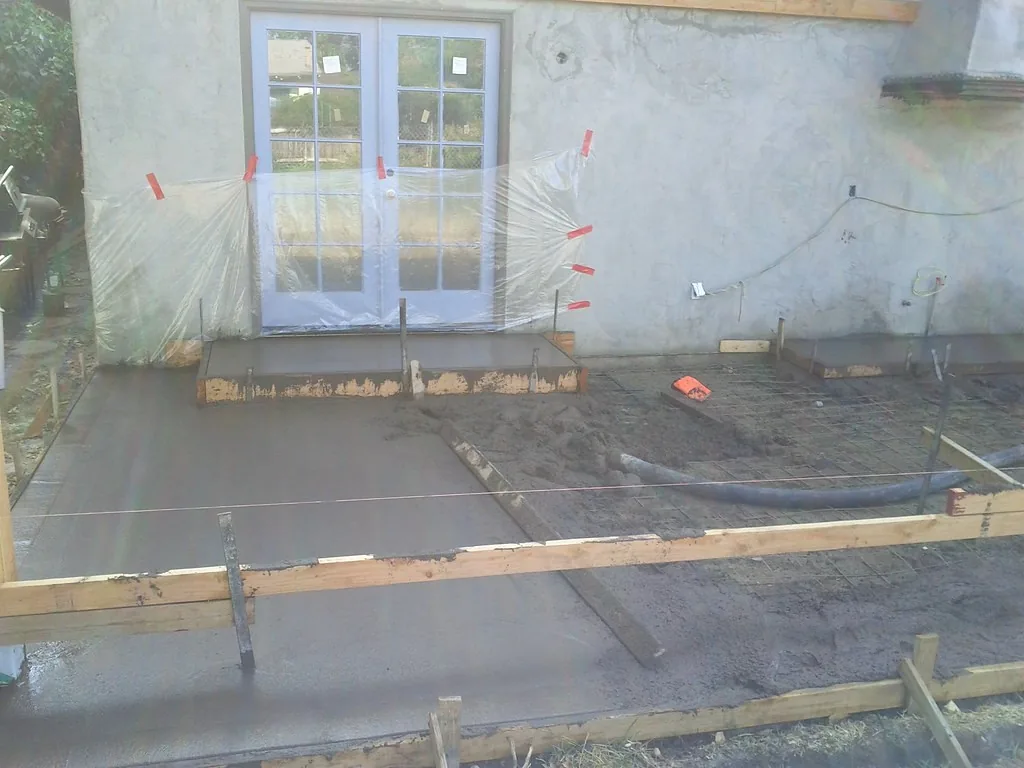
- Water on the surface: ponding, continuous sprinkling or fogging, or wet burlap and cotton mats kept wet. NRMCA says alternate wetting and drying is not acceptable.
- Plastic sheeting: at least 4 mils thick, laid directly on the concrete, edges overlapped and weighted. NRMCA recommends reflective (white) sheets in warm weather.
- Liquid membrane curing compound: sprayed at the recommended rate as soon as the water sheen leaves the surface after final finishing. NRMCA says two coats at right angles are desirable, and a white pigment reflects heat and shows coverage.
- Waterproof curing paper: used like plastic and less likely to mark the surface.
On most homeowner slabs the curing method is chosen by the contractor. If yours uses water or sheeting, they may ask you to keep the covers in place or keep the surface wet for a set number of days. That instruction is the part of curing you control.
Why curing matters so much
Skipping or shortening curing costs strength and surface quality. NRMCA says concrete in a dry environment can lose as much as 50 percent of its potential strength compared with moist-cured concrete. It also says proper curing reduces crazing, dusting and scaling and gives a harder, more wear-resistant surface. ACI adds that the most rewarding period for curing is the first few days or weeks: moist curing after early drying can restore some strength, but not all, and shrinkage damage may already be done.
ACI also notes that inadequate early curing frequently causes plastic shrinkage cracking, which leaves a weak, badly cracked surface. If your new slab shows a set of short parallel surface cracks, the concrete slab cracks guide explains what they usually mean.
Curing time in Las Vegas weather
Hot weather
In heat the danger is not slow curing but fast drying. ACI says high temperatures speed hydration, raising early strength and lowering later strength, and NRMCA's hot-weather rule is to keep curing for at least 3 days. In a valley where the airport averages 78.2 days a year at or above 100F, keeping the slab wet or covered matters more than the calendar.
Cold weather and winter
Las Vegas winters are mild but not frost-free. The airport averages 9.8 nights a year at or below 32F, mostly in December and January. Lows away from the airport, in the higher west and the outer edges of the valley, can dip further, per NWS. ACI says hydration is greatly retarded below 40F, and that between 40F and 60F satisfactory results come from prolonging the moist curing period. NRMCA says to protect new concrete from freezing until it reaches 500 psi, about two days after placement, and not to let it cool faster than 5F per hour over the first 24 hours.
Rain
Rain is not a curing problem once the surface has hardened, since water is what curing needs. The concern is a downpour on a surface that is still being finished. The airport averages 4.18 inches of rain a year, and the summer monsoon storms NWS describes for July and August can be heavy. If storms are forecast, ask how the slab will be covered.
Other curing questions people ask
How long does concrete take to cure with an accelerator?
Accelerators shorten setting time. NRMCA covers them in its cold-weather guidance and notes they may also be used in hot weather to speed finishing. NRMCA caps calcium chloride at 2% by weight of cement. An accelerator does not remove the need to cure.
Does concrete cure under water?
Yes, hydration needs water, and ponding water on a slab is one of the curing methods NRMCA lists. That is different from pouring into standing water, which is a placement question for the contractor.
How long does cement take to cure?
Cement is the powder that binds concrete together; what cures on a slab is the concrete. The timelines on this page apply to concrete.
Fence posts, post holes and pool decks
Post holes and bagged post-setting mixes follow the bag maker's instructions, and they are outside what this site covers. Pool decks are flatwork like any other slab, so the curing figures above apply.
Next steps
If you are pricing a slab, start with the Las Vegas concrete slab cost guide, pick the job closest to yours such as a patio slab, check the service area, or send a quote request.