Concrete garage slabs in Las Vegas, NV: the short answer
A concrete garage slab in Las Vegas, Nevada is a 4 to 6 inch reinforced floor poured on a compacted base. For a typical two-car size of 400 to 576 square feet, expect roughly $2,400 to $7,000, with removal of an old floor or heavy caliche digging on top. If the garage itself is new and 200 square feet or more, it is permit work, and the slab gets built to the approved plans. People who search concrete garage slab Las Vegas mostly get epoxy floor ads back: this page is about the plain poured slab, not coatings.
What a garage slab costs in Las Vegas
Garage slabs are where the Las Vegas sources spread out most. HomeBlue's Las Vegas size table runs well above the national guides, while projectcosted's Las Vegas model sits close to them. The table puts the published figures side by side with a plain estimate at the $6 to $12 per sq ft range most 2024 to 2026 guides give.
| Size | Sq ft | Published figures | Estimate at $6 to $12 / sq ft |
|---|---|---|---|
| 12 x 20 (one car) | 240 | None found | About $1,440 to $2,880 |
| 20 x 20 (two car) | 400 | LV: projectcosted $2,442 to $4,885; HomeBlue $4,100 to $7,000. National: HomeGuide $2,400 to $4,800 | About $2,400 to $4,800 |
| 24 x 24 (large two car) | 576 | National: HomeGuide garage floor, 400 to 576 sq ft, $2,400 to $6,900 | About $3,456 to $6,912 |
| 24 x 30 (two car plus shop) | 720 | None found | About $4,320 to $8,640 |
| 30 x 30 (three car) | 900 | LV: HomeBlue $9,100 to $15,700. National: HomeGuide $5,400 to $10,800 | About $5,400 to $10,800 |
| 30 x 40 (shop or RV garage) | 1,200 | LV: HomeBlue $12,200 to $20,900 | About $7,200 to $14,400 |
Swipe the table sideways to see every column →
Sources: projectcosted Las Vegas (Aug 2026); HomeBlue Las Vegas concrete slab cost (Sep 2024); HomeGuide concrete slab cost (Feb 2026, national). Estimates multiply the area by HomeGuide's $6 to $12 per sq ft and are not quotes. Angi prices a 350 sq ft garage floor at $2,100 (national, Apr 2026). Car-count labels are rough.
How much concrete a garage slab takes
One cubic yard covers about 81 square feet of 4 inch slab (HomeGuide). That makes a 24 x 24 garage about 7 cubic yards at 4 inches and close to 11 at 6 inches, before any thickened edges. In Las Vegas, HomeBlue (March 2025) lists ready-mix at $143 to $150 per yard for 3,000 psi, $153 to $161 for 4,000 psi and $164 to $172 for 5,000 psi, with delivery at $130 to $290 per truck. Labor, base prep, forms, reinforcement and finishing make up the rest; projectcosted splits a 400 sq ft Las Vegas slab at about 50% labor and 36% materials.
What pushes a garage slab quote up
- Removing an old garage floor: $1.30 to $2.10 per sq ft in Las Vegas (HomeBlue), $3 to $8 nationally with disposal, plus $1 to $3 more for reinforced concrete (HomeGuide).
- Going from 4 to 6 inches: roughly $2 per sq ft more in HomeGuide's table.
- Soil work: overexcavating and replacing expansive or collapsible soil, or breaking out caliche.
- Details the permitted plans call for, which can include thicker edges under the walls.
- A driveway connection or curb work, which can need a right-of-way permit.
Every per-foot source with its date is in the Las Vegas concrete slab cost guide.
Garage slab requirements: permits, setbacks and plans
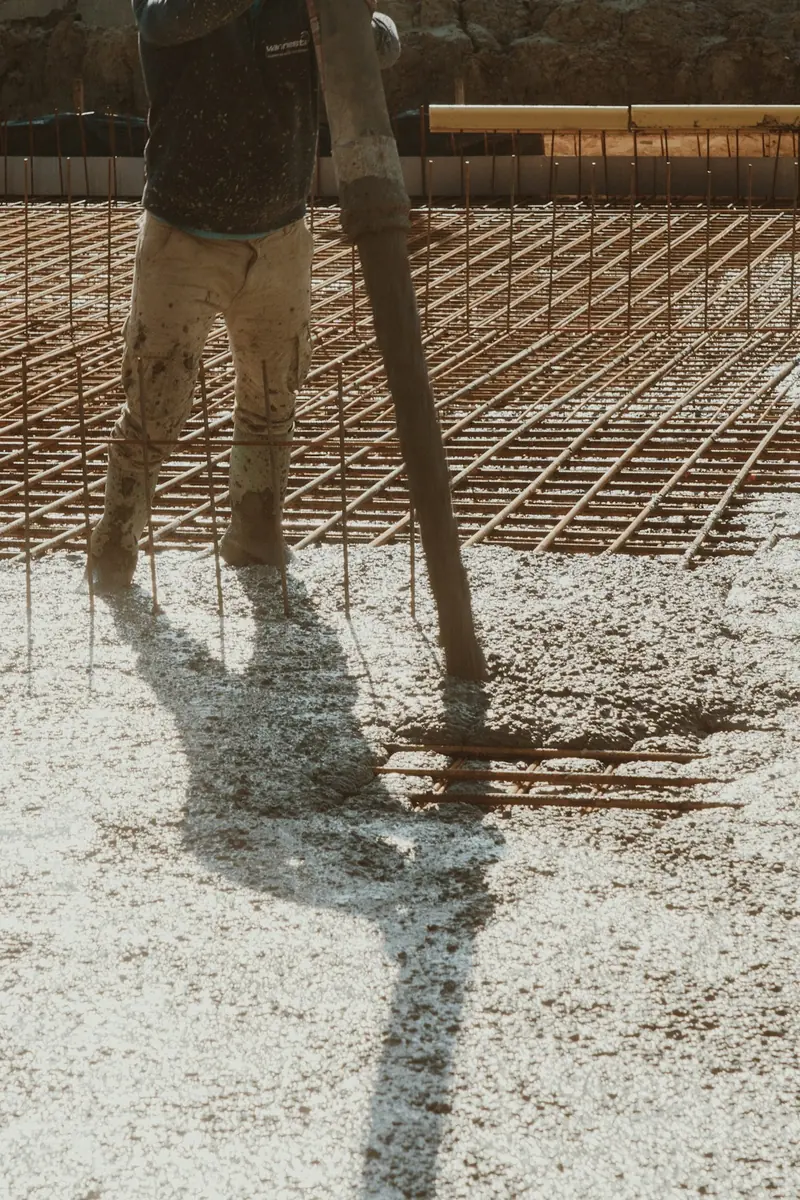
The slab and the building are treated differently. A bare slab on grade, no more than 30 inches up, is exempt from a building permit everywhere in the Valley. A garage is a building: the City of Las Vegas lists building, demolishing or moving a garage of 200 square feet or larger as permit work, and Clark County, Henderson, North Las Vegas and Boulder City only exempt accessory buildings up to 200 square feet. So the slab under a new garage is poured to the permitted plans, which set its thickness, reinforcement and edges.
- Setbacks: in the City of Las Vegas, detached accessory structures in the rear yard sit at least 3 ft from side and rear property lines and 6 ft from the house. Detached structures aren't allowed in the front yard unless it's a side-loaded garage.
- HOA approval: master-planned communities such as Summerlin North require committee approval before any exterior construction, and the garage's design will be reviewed along with the slab.
- Driveway: a new garage usually needs a driveway to reach it. Summerlin North and Southern Highlands both tie driveway width to the garage, and any work in the street right-of-way needs its own permit.
- License limits: every Nevada contractor license carries a monetary limit, and a contract above it is void (NAC 624.640). A large garage slab can exceed a small limit, so check the limit printed on the bid.
The exemption list for each city is in the Las Vegas concrete slab permit guide.
Garage slab thickness, reinforcement and slope
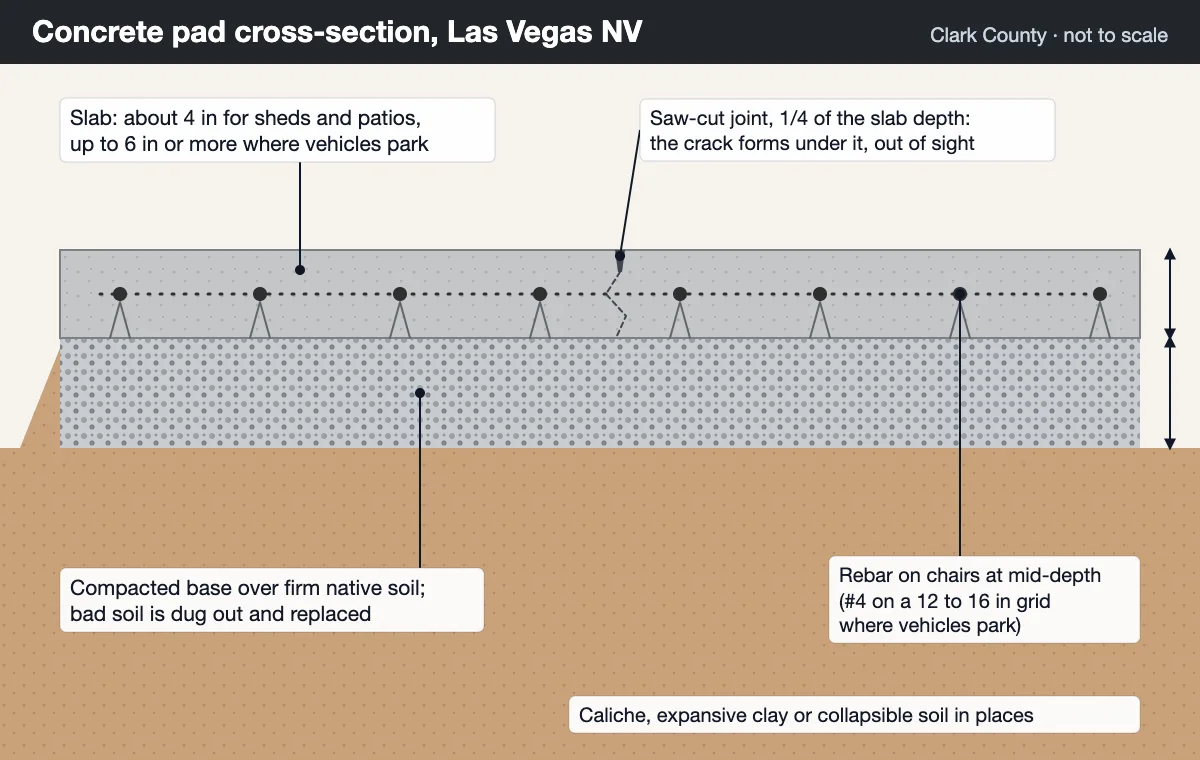
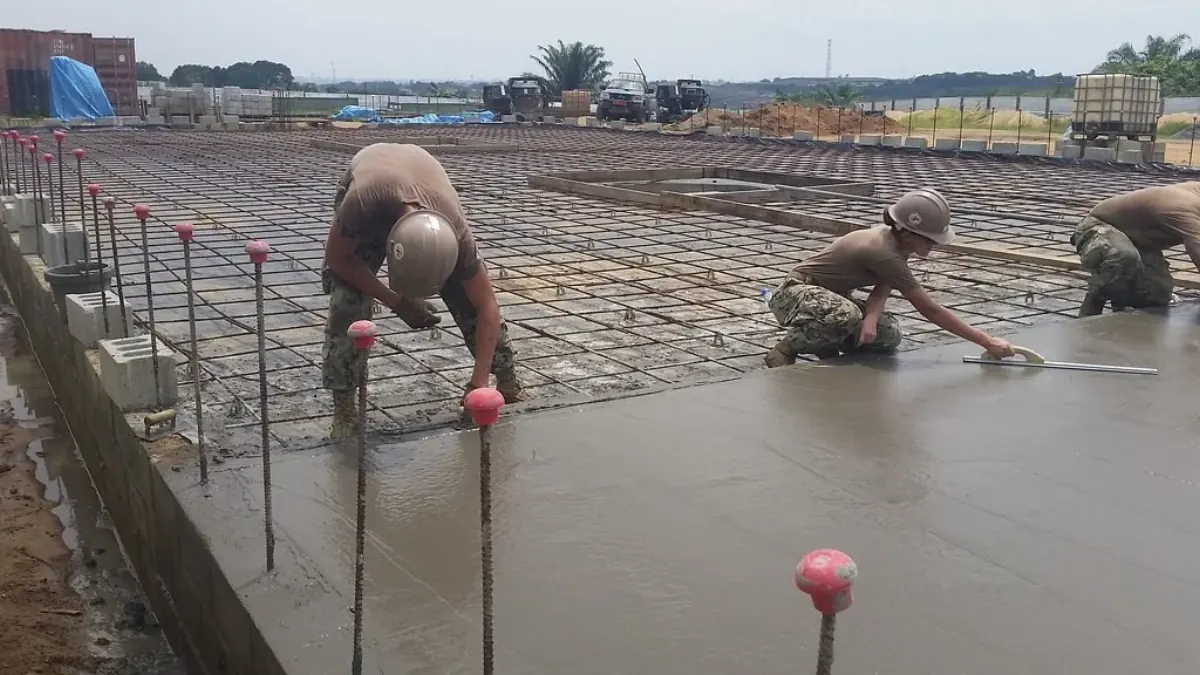
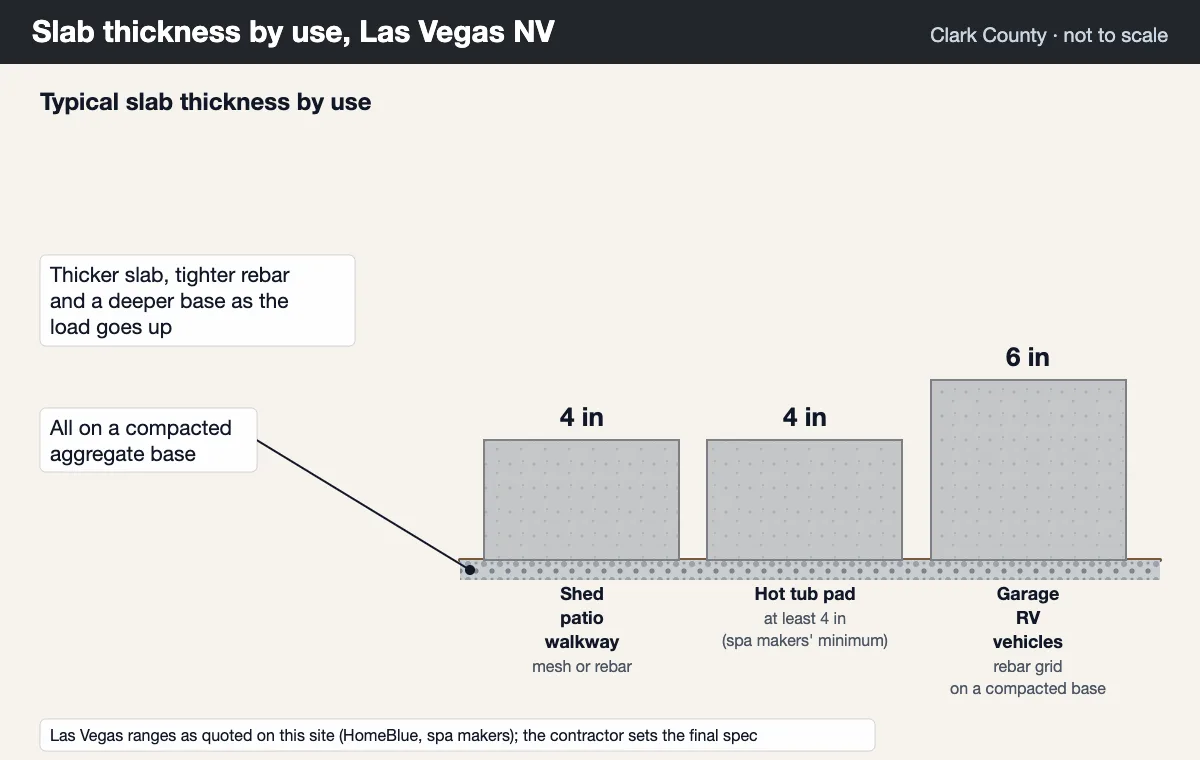
Garage floors typically run 4 to 6 inches, and reinforcing them with rebar or wire mesh is common (HomeBlue). HomeAdvisor notes rebar is used to reinforce slabs thicker than 4 inches. On a permitted garage, the approved plans set the numbers, which is why we don't quote a single code figure here. See the concrete slab thickness guide for how garage floors compare with patios and pads.
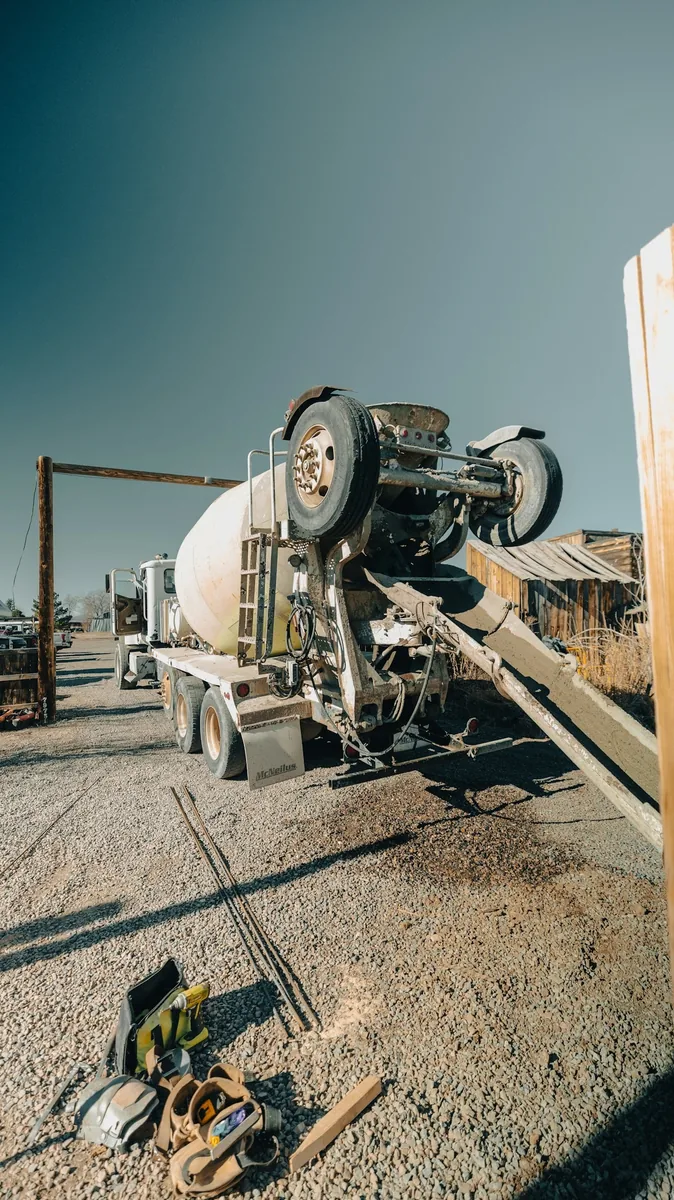
Las Vegas Valley soil under a garage slab
A garage slab is big and carries real weight, so the soil under it matters more than under a patio. A 2016 geohazards presentation to the Southern Nevada chapter of the ICC lays out the local conditions and the usual responses:
| Condition | Where | Usual response |
|---|---|---|
| Sulfate attack | Throughout Southern Nevada | A more sulfate-resistant concrete mix |
| Expansive clays | More severe in the north and east Valley | Overexcavation and replacement, a modified slab system, moisture conditioning |
| Hydrocollapsible soils | North and east Valley | Overexcavation |
| Earth fissures | Middle to north Valley | Overexcavation and geo-fabrics |
| Chemical heave | Usually near washes | A thermal barrier under the slab |
| Caliche | Erratic across the Valley | Strong bearing surface; the cost is in removal, and partial support can cause uneven settlement |
Sources: Bowman, 'Geohazards in Southern Nevada', SNICC presentation (May 11, 2016); Werle and Luke, 'Engineering with Heavily Cemented Soils in Las Vegas, Nevada' (UNLV, 2007). Clark County's expansive soil map rates near-surface soils from 'None to Low' (0 to 4%) to 'Critical' (over 12%) but says site conditions can vary considerably.
Clark County's expansive soil guidelines map is a good first look at your area, and the map itself advises asking a registered design professional for site-specific recommendations. Our caliche and concrete slabs guide covers the hardpan in more depth.
Pouring a garage slab in Las Vegas heat
A garage slab is a large pour with a long finishing window, which is exactly what Las Vegas summers squeeze. The airport averages 40.5 days a year at or above 105°F, and ACI's hot-weather specifications cap concrete at 95°F at delivery unless the mix is proven for hotter use. For large summer pours, NRMCA's hot-weather guidance (CIP 12 and CIP 5) lists early-morning placement, chilled water or ice and set retarders, followed by prompt curing. Read pouring concrete in Las Vegas heat and concrete curing time before planning when to park on it. HomeBlue's Las Vegas page gives 28 to 30 days for a full cure.
Replacing an old garage floor
Replacing a garage slab means breaking out the old floor, hauling it, fixing whatever moved the old slab, and pouring new. Removal alone runs $1.30 to $2.10 per sq ft in HomeBlue's Las Vegas figures and $3 to $8 in national guides, with reinforced concrete costing more to cut and haul. If the old floor cracked because the soil under it settled or swelled, replacing the concrete without fixing the base just repeats the problem. Ask your building department whether a floor replacement in your garage needs a permit. More in slab replacement and removal and the concrete slab cracks guide.
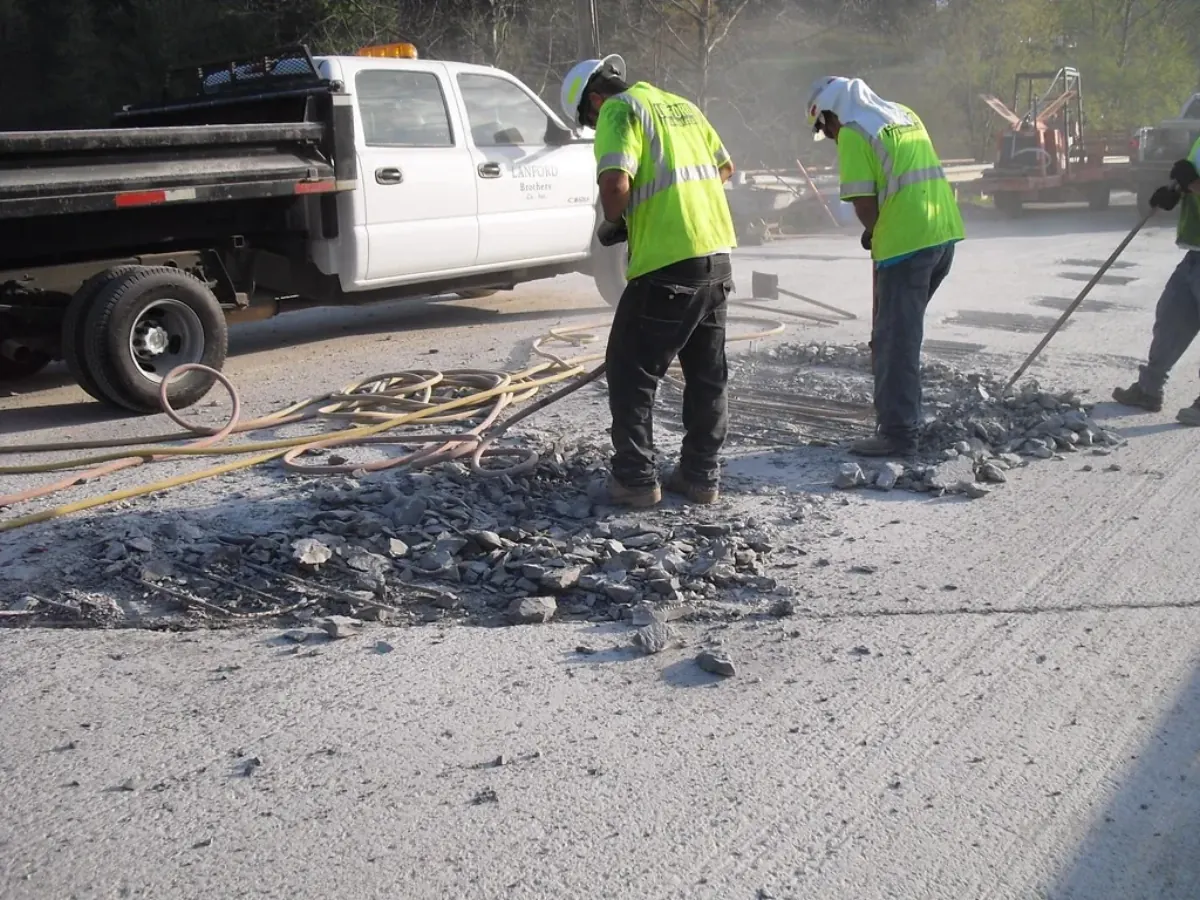
Signs your garage slab needs replacing
- One side of a crack sits higher than the other, enough to catch a tire or a toe.
- The floor has sunk at the door or along a wall, so water runs in rather than out.
- The surface is etched, scaling or crumbling, which sulfate attack can cause in Southern Nevada soil.
- Cracks keep widening year after year.
- You are converting the garage to a shop and need a floor that will take heavier equipment.
Checking the contractor on a garage slab
Nevada requires the license number and monetary limit on every bid. Bigger buildings have their own page: slabs for metal buildings, shops and RV garages. For an open cover instead of a garage, see carport slabs, and for parking outside, a concrete RV pad. Start from concrete slabs in Las Vegas, check the service area, or request a free quote.