Where Centennial Hills sits, and who regulates it
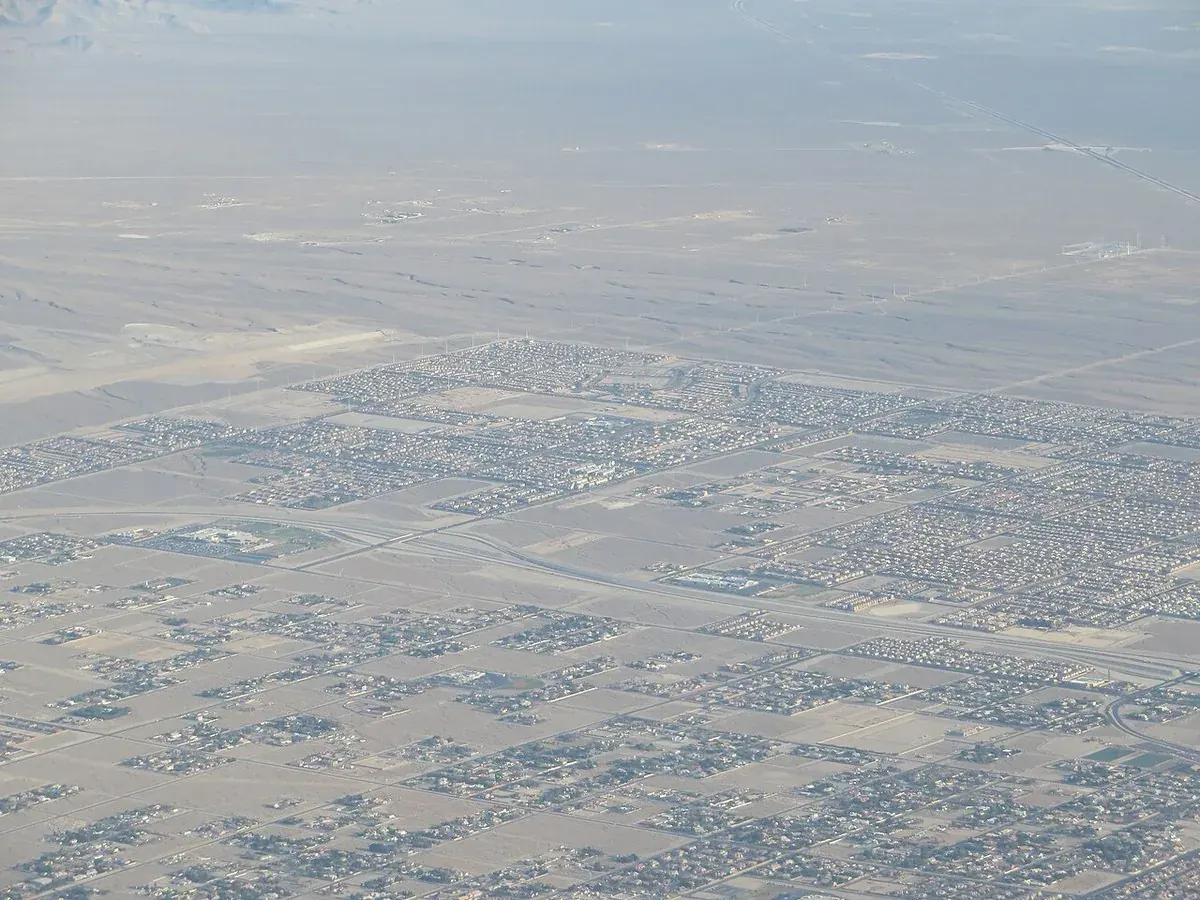
Centennial Hills is a neighborhood of the City of Las Vegas, not a separate town. Wikipedia places it in the city's northwest, bordered by the Snow Mountain Paiute Reservation and Tule Springs Fossil Beds National Monument to the north, Lower Kyle Canyon and the Red Rock Canyon National Conservation Area to the west, Summerlin to the south and North Las Vegas to the east. Its center is the interchange of I-11/US 95 and the CC 215 Beltway, built in 2003, and Lone Mountain lies within it. For a concrete slab Centennial Hills property owners plan, the City of Las Vegas Building and Planning departments are the offices that count.
The area is a mix. New construction spreads across the western foothills, while horse ranches and open terrain remain around Lone Mountain, where opponents of a proposed temple described the surroundings as a "low-rise, semi-rural neighborhood." Where a lot has room, the slab ideas grow with it: an RV pad down the side of the lot, a slab for a steel shop, or a wide patio.
RV parking rules that size the slab
The City of Las Vegas has two sources on RV parking, and they don't say quite the same thing. The Title 19 parking standards say all parking and vehicle storage, including RV parking in residential districts, "shall occur on paved areas," and list an RV parking space as 10 by 30 feet. The code enforcement department's Top 20 Questions sheet (2018) goes into more detail by yard location and lot size:
| Situation | What city sources say | What it means for a slab |
|---|---|---|
| Lot under 0.2 acres | No RV or trailer combination over 24 ft, end to end including hitches and bumpers | Larger rigs need a lot of 0.2 acres (about 8,700 sq ft) or more |
| Rear yard | Pavers at least 2 in thick, decomposed granite at least 2 in with defined borders, or concrete, asphalt, gravel or chat covering the RV's full length and width | Concrete works; the slab must be at least as long and wide as the rig |
| Side yard | Screened by a 6 ft fence, or on an approved concrete, asphalt or 2 in paver driveway covering the full RV | Behind a 6 ft fence and gate, or a full-size paved pad |
| Front yard | Allowed only if rear or side access isn't available, and only on an approved surface | A last resort, not a default |
| Any residential district (Title 19) | RV parking on paved areas; RV space 10 ft by 30 ft | Concrete satisfies both documents |
Sources: City of Las Vegas Code Enforcement, Top 20 Questions (file dated Aug 27, 2018); City of Las Vegas Title 19 Parking, Loading and Traffic Standards (PDF on the city's Zoning Code page). Read October 13, 2026. The two documents differ on gravel and DG; a concrete pad meets both. Confirm current rules with the city before building.
On a half-acre lot, for example, the 24-foot cap doesn't apply, so a long fifth-wheel or motorhome can stay at home if there is a paved spot for it. Because both city documents accept concrete, a full-length concrete pad is the one surface that removes the doubt. Start with the concrete RV pad page for thickness and reinforcement, then the RV pad size guide for length and width with room for slide-outs and walking space.
Shops, RV garages and other buildings on a slab
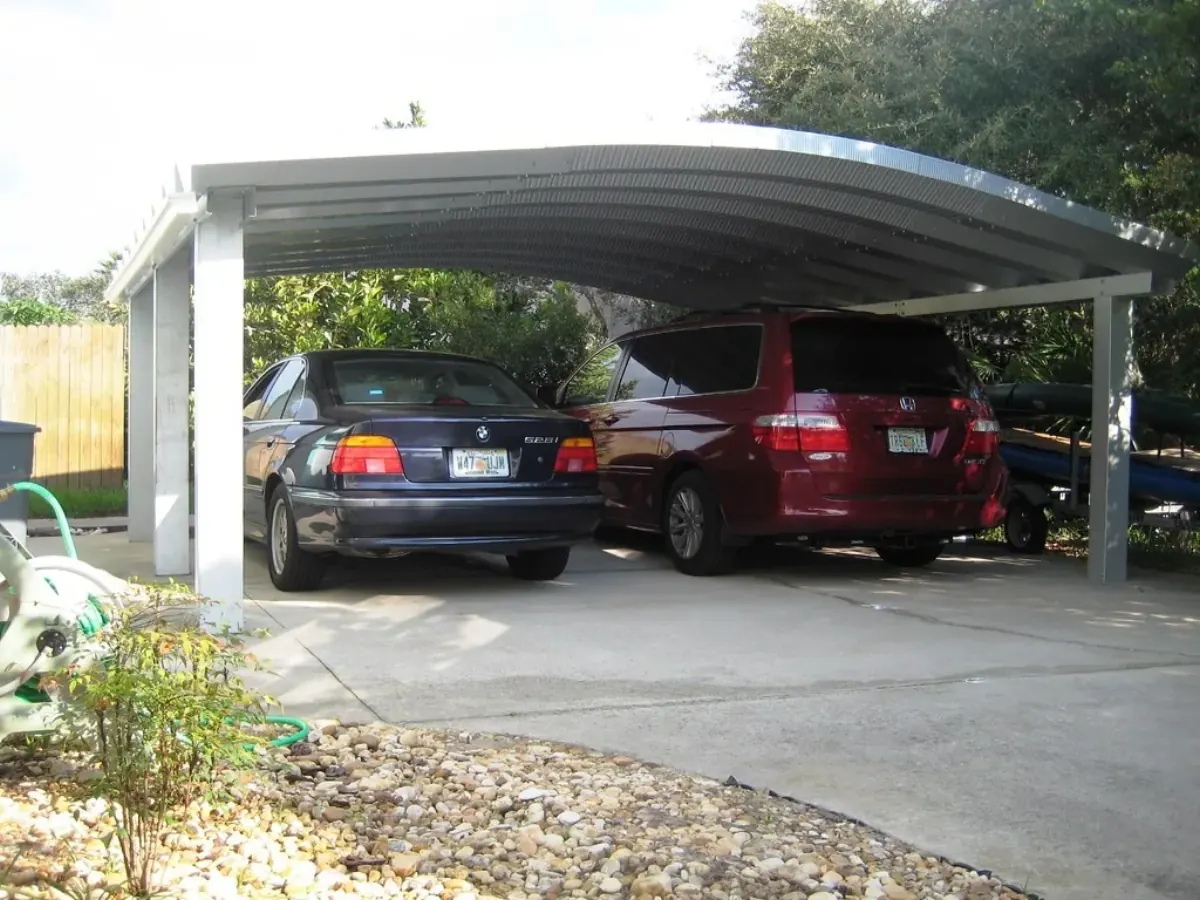
Larger lots invite larger buildings, and those change the permit picture. The city's homeowner permit guide exempts a non-habitable one-story detached structure only up to 200 square feet with no electrical, plumbing or mechanical work, and says a permit is required to "build, demolish, or move a carport, garage, or shed of 200 square feet or larger." A steel shop, an RV garage or a big carport is permit territory, and the slab under it is usually designed with the building: anchor bolt layout, thickened edges and door openings all have to be set before the pour.
Where the building goes is set by zoning. The city's Title 19 development standards put detached accessory structures in the rear yard at least 3 feet from side and rear property lines and 6 feet from the house, and bar them from the front yard unless the structure is a side-loaded garage. See the metal building slab page, the garage slab page and the carport slab page.
Skye Canyon: what we can and can't say
Skye Canyon is a master-planned community in northwest Las Vegas at US 95 and Skye Canyon Park Drive, ZIP 89166. Its developer lists about 6,500 homes, from entry-level to luxury, and 250,000 square feet of retail and restaurant space including a 124,000 square foot Smith's Marketplace. It has its own community association.
On jurisdiction, the evidence points to the City of Las Vegas: the Skye Canyon Exhibit M Design Guidelines are hosted on the city planning department's own file server. No page we read states the jurisdiction outright, though, so check your parcel record before you assume which rules apply. The design guidelines themselves are a 128-page image-only PDF that we couldn't extract, so ask the Skye Canyon association for its current rules on patios, sheds and RV parking before you plan a slab there.
A nearby HOA with written RV pad rules: Providence
Providence, another northwest Las Vegas master plan, is one of the few local HOAs whose rules on RV pads we could read. Its Design Review Guidelines (amended and restated May 2021) show how much an HOA can add to the city rules:
| Topic | Rule |
|---|---|
| Approval | Every exterior modification needs a Design Review Application and approval before work starts |
| RV parking | No RV parked, stored or kept on a lot without prior written DRC approval |
| RV pad location | Considered only with enough side-yard room behind the front setback, plus a 6 ft wall and a 6 ft double gate with full mesh screening |
| RV pad clearances | At least 6 ft between the common wall and the house; at least 10 ft between the rear wall and the pad |
| Hardscape limit | Hardscape limited to 20% of the lot area, pool decking excluded |
| Driveway additions | At least 3 ft of landscape on each side and a hard surface matching existing hardscape |
| Sheds and structures | Shed height max 10 ft; patio covers, sheds and similar at least 5 ft setback |
Source: Providence Master HOA, Design Review Guidelines, amended and restated May 2021 (providencelvhoa.com PDF), read October 13, 2026. These rules apply to Providence only; Centennial Hills subdivisions with their own HOA will have their own documents.

Questions people ask about slabs up here
Does a concrete slab crack, and does it shrink?
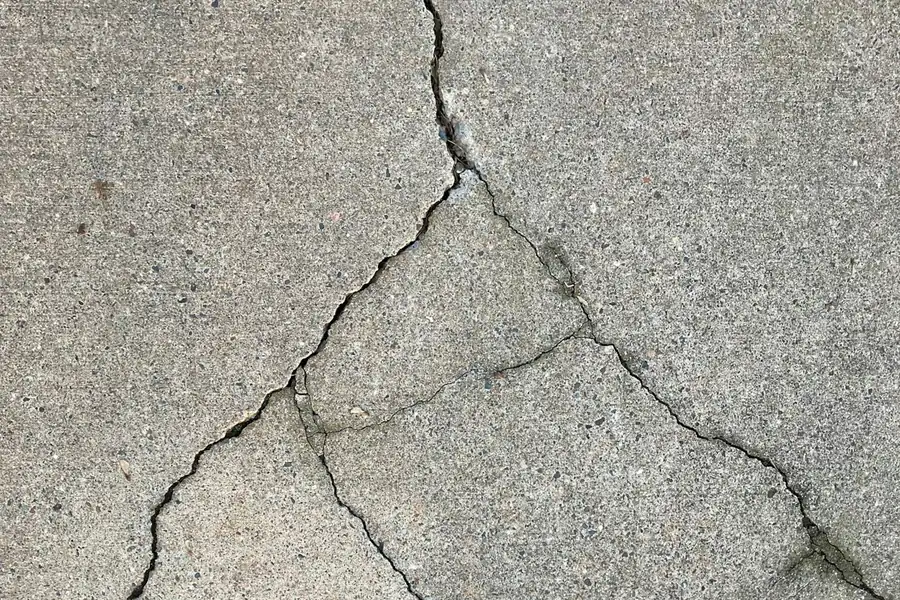
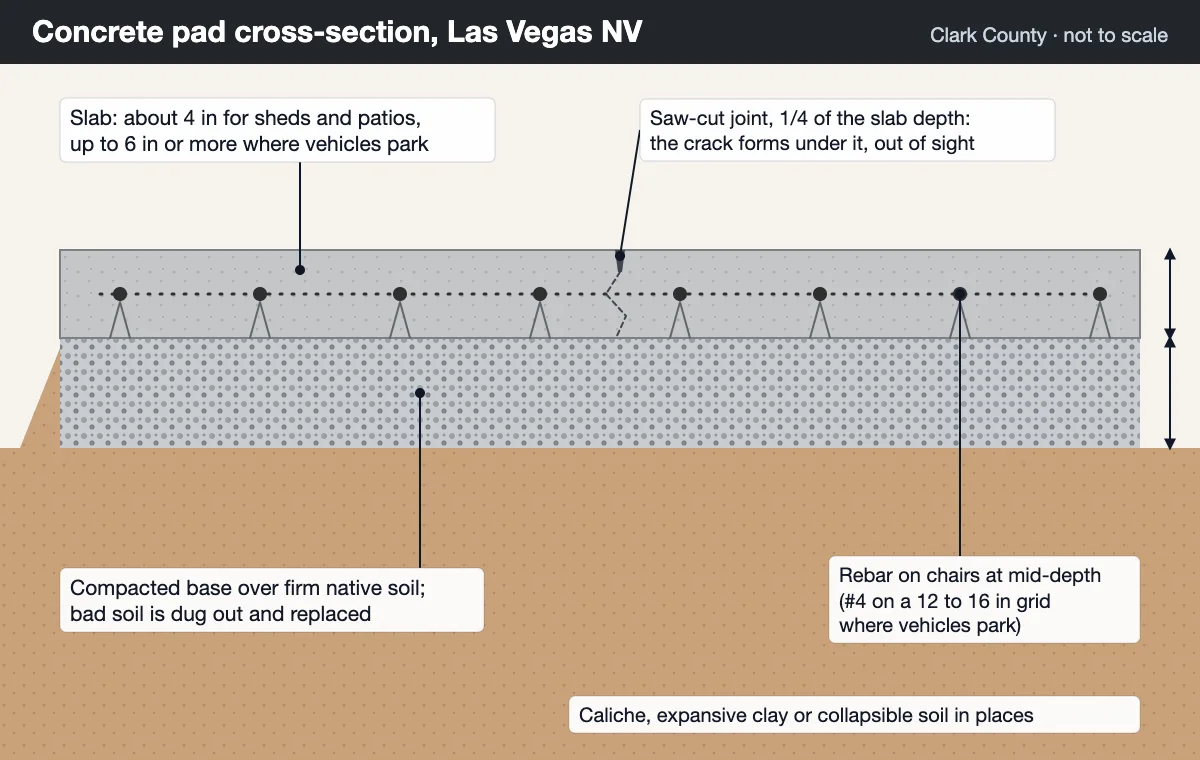
Yes to both, in a normal way. Concrete loses volume as it dries, and that shrinkage is what control joints are for: they give the crack a place to happen in a straight line. A hairline crack along a joint is the slab working as designed. A crack that is wide, growing or has one edge higher than the other usually means the ground under it moved. The slab cracks guide explains the difference.
Does the ground here cause problems?
A 2016 geohazards presentation to the Southern Nevada ICC chapter places expansive and collapsible soils mainly in the north and east of the valley and fissures mostly in the middle to north. Centennial Hills borders North Las Vegas, so it is reasonable to ask a contractor how they will check the base. Caliche, the lime-cemented layer found across Southern Nevada, adds digging cost but is a good bearing surface where it is continuous. See caliche and concrete slabs.
Does a slab need a permit?
The City of Las Vegas guide lists private slabs, sidewalks and driveways up to 30 inches above grade, not over a basement, as not needing a permit, with an offsite permit if any part of a driveway is in the public right-of-way. Buildings over 200 square feet need one. The full comparison is in the Las Vegas slab permit guide.
Prices for bigger slabs
Large slabs usually come in lower per square foot than small pads, because the crew, truck and setup are spread over more area. Current Las Vegas area sources put a plain reinforced slab at $7 to $12 per square foot (HomeBlue, September 2024) or $6.11 to $12.21 (projectcosted, August 2026). HomeBlue's sized figures include $6,100 to $10,400 for 20x30 and $12,200 to $20,900 for 30x40, a size people often search for metal buildings. No published figure exists for RV pad sizes in Las Vegas, so the table below is arithmetic at HomeGuide's national $6 to $12 range, not quotes.
| Footprint | Area | Estimate at $6 to $12 per sq ft |
|---|---|---|
| RV pad, 12 x 40 ft | 480 sq ft | $2,880 to $5,760 |
| RV pad, 14 x 50 ft | 700 sq ft | $4,200 to $8,400 |
| Shop or RV garage, 24 x 30 ft | 720 sq ft | $4,320 to $8,640 |
| Shop, 30 x 40 ft (HomeBlue Las Vegas, published) | 1,200 sq ft | $12,200 to $20,900 (published figure) |
Estimates computed from HomeGuide's national $6 to $12 per sq ft range (Feb 3, 2026); the 30x40 row is HomeBlue's published Las Vegas figure (Sep 27, 2024). Thicker slabs, rebar, long approaches, caliche removal and building anchor layouts add cost.
More detail is in the Las Vegas slab cost guide and slab cost by size. Smaller jobs are covered on the patio slab and shed slab pages.
Northwest valley checklist
- Check your lot size against the city's 0.2-acre threshold before buying a long RV or trailer.
- Size the RV pad to the rig's full length and width, plus walking room.
- Any building over 200 sq ft: plan the building permit and the slab together.
- In an HOA (Skye Canyon, Providence or another), get written approval before work starts.
- Ask any bidder for a Nevada C-5 license number and monetary limit, printed on the bid; a large shop slab can exceed a small license's limit.