Last reviewed October 2026
Pavers vs concrete in Las Vegas comes down to four things: price, how the surface handles the ground under it, what your HOA allows, and whether the area is part of a turf conversion rebate. This site is about plain poured concrete slabs, so we have an interest in the concrete side. We have kept the comparison to sourced figures, and where pavers win, we say so.
One scope note: stamped and decorative concrete is a separate trade that this site does not cover. The comparison below is plain poured concrete, such as a broom-finished patio slab, against interlocking pavers.
Cost: pavers vs concrete per square foot
Concrete costs less up front. HomeGuide's paver patio guide puts installed pavers at $10 to $17 per square foot and a concrete slab at $4 to $8, so pavers cost about twice as much. Its driveway comparison shows the same pattern: $10 to $30 per square foot for a paver driveway against $6 to $15 for concrete. No Las Vegas-specific paver price was found in our research, so the paver figures below are national.
| Size | Paver patio (national) | Plain concrete patio (national) | Concrete slab (Las Vegas) |
|---|---|---|---|
| Per sq ft | $10 to $17 | $4 to $12 | $7 to $12 reinforced |
| 10x10 (100 sq ft) | $950 to $1,700 | $400 to $1,200 | $1,000 to $1,700 |
| 12x12 (144 sq ft) | $1,400 to $2,500 | $600 to $1,700 | No published figure |
| 20x20 (400 sq ft) | $3,800 to $6,800 | $1,600 to $4,800 | $4,100 to $7,000 |
Swipe the table sideways to see every column →
Sources: HomeGuide paver patio installation cost (September 18, 2024); HomeGuide concrete patio cost (July 10, 2025); HomeBlue Las Vegas concrete slab cost (September 27, 2024). National columns are not Las Vegas prices. HomeBlue's Las Vegas sizes run higher than the national concrete column, and its 10x10 figure includes a minimum charge.
Two things stand out. The Las Vegas concrete figures sit above the national concrete averages, so do not compare a local concrete bid against national paver numbers and assume the gap is the same. And at small sizes the two converge, because a concrete crew and truck cost roughly the same to send for a small pad as a large one. The Las Vegas concrete slab cost guide and cost by size guide go deeper on the concrete side.
What goes into each price
HomeGuide breaks a paver patio into paver materials, a compacted base (Class II road base gravel, geotextile fabric, edging or a concrete bond beam, bedding sand and joint sand, listed at $1.40 to $2.20 per square foot) and labor at $6 to $11 per square foot. A concrete slab's cost is mostly labor, concrete and reinforcement, plus site prep. In this valley that site prep can include breaking through caliche, a cemented hardpan covered in our caliche guide. Either material needs the ground prepared, so a hard digging site raises both bids.
SNWA Water Smart Landscapes: where pavers have an edge
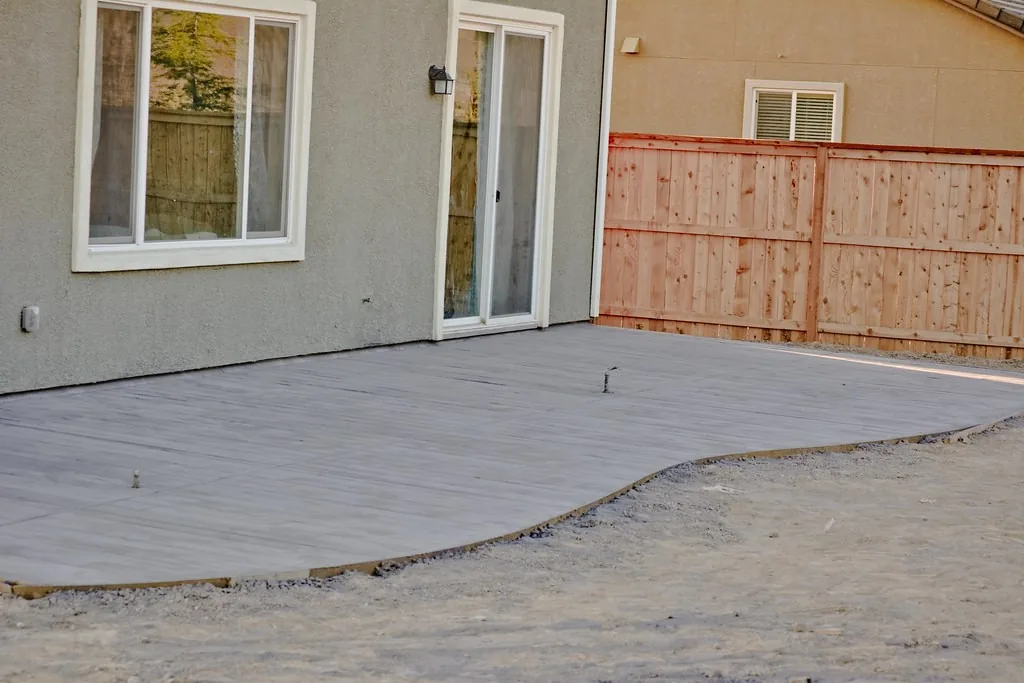
If you are pulling out lawn with the Southern Nevada Water Authority rebate, the material choice matters. SNWA pays residential properties $5 per square foot of grass removed and replaced with desert landscaping, up to the first 10,000 square feet, and $2.50 per square foot after that. Las Vegas Valley Water District customers can get an additional $2 per square foot, and Henderson offers an additional $575.
The catch for concrete is written into SNWA's residential terms. The conversion area must be uniformly permeable to air and water and covered by mulch, such as rock, bark, ungrouted pavers, permeable artificial turf or living groundcovers. Plastic, concrete and other impermeable materials are not allowed. If a project includes a concrete patio, SNWA says that area will be excluded, though the surrounding areas may still qualify.
- A concrete slab never earns the rebate. Its footprint is carved out of the rebated area.
- Ungrouted pavers are on SNWA's list of acceptable permeable covers, but the converted area must still reach at least 50 percent living plant cover at maturity, so a paver patio is not a free pass either.
- At least 400 square feet of lawn has to be converted to apply.
- Removing the lawn before SNWA approves the project makes the conversion ineligible.
- A rebated area carries an easement that commits you to keep the conversion in place or repay the incentive plus fees.
The practical reading: you can pair a concrete patio with a rebated rock and plant conversion of the rest of the lawn, as long as the patio area is left out of the rebate and SNWA approves the plan before any grass comes out.
HOA rules: hardscape caps apply to both
Most master-planned communities in the valley review hardscape before it goes in, and their caps count pavers and concrete alike. A few sourced examples:
| Community | Hardscape limit | Material notes |
|---|---|---|
| Summerlin North | Horizontal hardscape max 60% of front and side yard; 40% must be softscape | Hardscape includes walkways, driveways, rock mulch, patio slabs and pool decking; artificial turf counts as hardscape; driveway expansion must match or complement the existing driveway |
| Providence (northwest Las Vegas) | Hardscape max 20% of the lot; pool decking not counted | Concrete work including paving stones needs a site plan review showing location, type, style and color |
| Inspirada (Henderson) | Added concrete must stay in proportion to unit and lot size | Driveways may be smooth concrete, stamped concrete, brick or interlocking pavers; asphalt, sand and gravel are not permitted; colored concrete must use integral color |
| Southern Highlands (Enterprise) | Driveway width may not exceed the garage footprint | Driveway materials may include concrete, stained or stamped concrete and paver stones |
Sources: Summerlin North Community Association Design Guidelines (January 1, 2025); Providence Master HOA Design Review Guidelines (May 2021); Inspirada Community Association Design Review Guidelines; Southern Highlands Homeowner Design Manual (May 31, 2017). Sub-associations can be stricter. Check your own HOA's current rules before you buy either material.
The takeaway: in Summerlin North or Providence, switching from concrete to pavers does not create room under the cap. Approval comes first either way. Summerlin North also requires that patio slabs not alter the lot's original drainage, which matters for any hard surface in a backyard.
Side by side: concrete slab vs pavers
| Factor | Plain concrete slab | Pavers |
|---|---|---|
| Upfront cost | Lower: $4 to $8 per sq ft nationally; $7 to $12 in one Las Vegas guide | Higher: $10 to $17 per sq ft for a patio nationally |
| Ready to use | Curing period of about a week; strength specified at 28 days | Usable right after installation |
| Repair | Cracked sections are cut out and replaced; patches rarely match in color | Individual pavers lifted and replaced |
| Lifespan (driveways, per HomeGuide) | 20 to 30 years | 25 to 75 years |
| Strength | 3,500 to 4,000 psi typical for driveways, per HomeGuide | Concrete pavers have a minimum 8,000 psi, per HomeGuide |
| SNWA rebate area | Not allowed; carved out | Ungrouted pavers listed as an acceptable cover |
| Upkeep | Washing and periodic sealing, per HomeGuide | Weed pulling and joint sand, per HomeGuide |
Sources: HomeGuide driveway pavers cost (January 6, 2026) and paver patio installation cost (September 18, 2024); HomeBlue Las Vegas (September 2024); SNWA residential terms. Lifespans and upkeep are consumer guide figures.
How Las Vegas ground and climate affect the choice
Caliche and expansive soil
The Las Vegas soil series, named for the city, has a cemented caliche hardpan only 3 to 14 inches down according to the USDA description. A UNLV engineering paper notes caliche is an excellent bearing surface but can cause damage indirectly, through differential settlement when part of a structure sits on caliche and part on compressible soil. Clark County's expansive soil map also flags areas of high and critical clay swell. Ground movement affects both materials, and the repair differs: HomeGuide notes single pavers can be replaced, while a badly cracked slab section has to be replaced. Base preparation matters for both.
Sulfates in the soil
A 2016 geohazards presentation to the Southern Nevada chapter of the ICC lists sulfate attack as a problem throughout southern Nevada, with sulfates reacting with cement in concrete and showing as etching. The remedy it gives is a more sulfate-resistant concrete mixture, a point worth raising with any concrete contractor.
Freeze-thaw
HomeGuide's comparison lists freeze-thaw as a weakness for both materials. In Las Vegas that is a minor factor: the airport averages 9.8 freezing nights a year, though higher parts of the valley run colder.
When concrete makes more sense
- Budget comes first: concrete is roughly half the installed cost per square foot in the national figures.
- The surface will carry weight: a shed, a hot tub, an AC condenser, a car or an RV. For these jobs see the shed slab, hot tub pad and concrete RV pad pages.
- You want one continuous surface with control joints instead of many paver joints to keep weeded.
- The area is outside any SNWA conversion, so the rebate rules do not apply.
When pavers make more sense
- The area sits inside a planned SNWA turf conversion and you want a hard surface that SNWA lists as permeable.
- You expect utility work under the surface later, since pavers can be lifted and relaid.
- Your HOA or existing driveway already uses pavers and new work must match, as Summerlin North requires for driveway expansions.
- You want to use the surface immediately rather than wait for concrete to cure.
Getting a concrete price
If concrete is the fit, the jobs this site covers include a patio slab, a driveway extension and side yard concrete. Check the service area or send a quote request.