A county town, so county rules
Spring Valley is an unincorporated town and census-designated place in Clark County, about 2 miles west of the Las Vegas Strip. It counted 215,597 people in the 2020 Census, more than most Nevada cities, but it was never incorporated, so the Clark County Commission governs it. For anyone looking up a concrete slab Spring Valley NV permit, that means skipping the City of Las Vegas pages entirely. Wikipedia describes its boundaries as Sahara Avenue on the north, Decatur Boulevard on the east, Warm Springs Road on the south and Hualapai Way on the west, though a mailing address there still reads "Las Vegas."
| Rule | Source | Effect on your project |
|---|---|---|
| Walks and driveways up to 30 in above grade, not over a basement, need no building permit | Clark County Code 22.02.190(E) | Driveway extensions, walks and side yard strips at grade are exempt from the building permit |
| Platforms up to 30 in with a single-family home need no building permit | 22.02.190(F) | Patio, hot tub and equipment slabs at grade are covered |
| One-story sheds up to 200 sq ft with no mechanical or plumbing need no building permit; one lighting and one power circuit allowed, with an electrical permit | 22.02.190(A) | A shed slab and small shed are exempt; the wiring isn't |
| Type B fencing including retaining walls up to 24 in is exempt | 22.02.190(L) | A taller wall to level a slab on a slope needs a permit |
| Single-family driveways and parking areas in Hydrographic Basin 212 must be paved with concrete or asphalt | Title 30, 30.04.04(b) | No gravel or bare dirt parking for the house |
| Parking in unimproved or landscaped areas is prohibited; paving and dust control can't be waived | Title 30, 30.04.04(e) and (f) | A car or trailer on the rock yard is a violation |
| Maximum of 3 recreational vehicles at a residence; no living in an RV outside an RV park | Title 30 use standard; county code enforcement | Size RV pads for the three-vehicle limit |
| Encroachment permit for work in the public right-of-way | Clark County Public Works | Needed for curb cuts and sidewalk work |
| Grading plans filed with Public Works and a grading permit before work | County code enforcement | Applies when a project involves grading |
Sources: Clark County Code 22.02.190 (Municode, history through Ord. 4917, 2-15-2022); Title 30 Unified Development Code (latest amendment effective Sept 17, 2026); Clark County Code Enforcement zoning violations page; Clark County Public Works encroachment permits page. Read October 13, 2026. Exemptions cover the building permit only; setbacks still apply.
The same exemptions run, with small differences, across the City of Las Vegas, Henderson, North Las Vegas and Boulder City. The Las Vegas slab permit guide lines them up.
Why Spring Valley parking has to be concrete or asphalt
The paving rule is the one Spring Valley rule that turns a slab from optional to required. Title 30 says a 1-lot or single-family development inside the State of Nevada's Hydrographic Basin 212 "shall be paved with concrete, asphalt, rubberized asphalt, or asphaltic concrete", with exceptions only for nonurban roadway standards and agricultural uses. It then bans parking on unimproved or landscaped ground and states that the paving and dust control measures, which follow the Clark County Air Quality Regulations, "cannot be waived." Outside Basin 212, parking areas need not be paved but still fall under dust control. If you aren't sure which side of the line your parcel is on, ask Clark County Comprehensive Planning before choosing a surface.
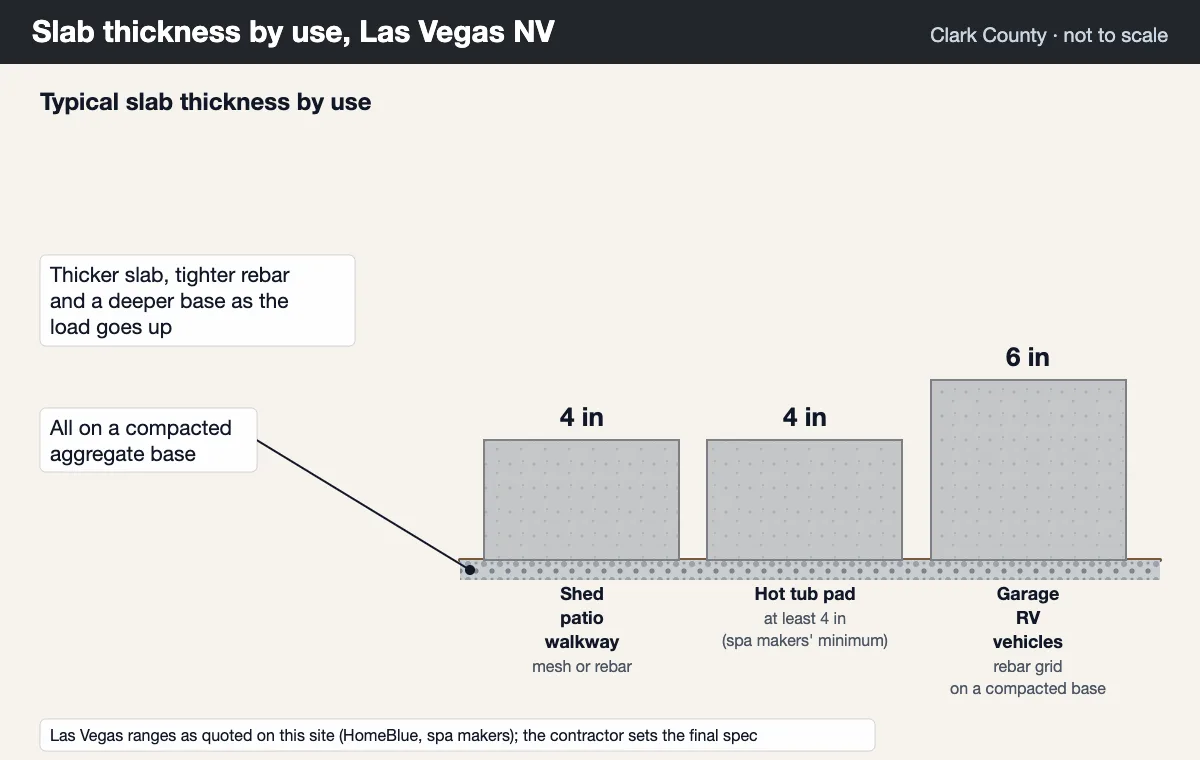
In practice, that is why a second car, a boat trailer or a work truck parked on the rock beside a Spring Valley driveway can draw a code complaint, and why a paved parking pad or driveway extension is the fix. For trailers and motorhomes, the concrete RV pad page covers slab thickness for the weight. For a shed that won't be parked on, gravel can still be fine; the gravel vs concrete pad guide weighs both.
North and south Spring Valley are different places to pour
The rural-estate north
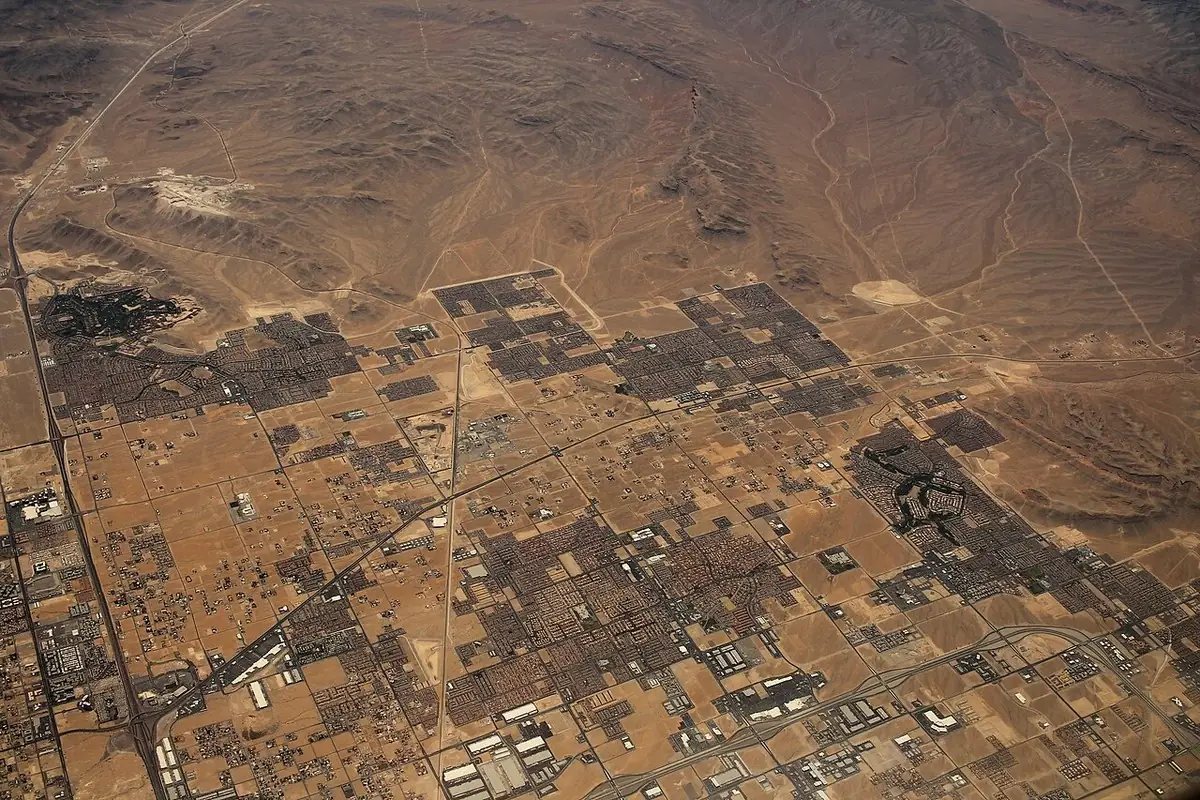
The northern part of Spring Valley includes areas of rural-estate zoning, laid out in large blocks of 1/64 square mile, according to Wikipedia's account of the town. Bigger parcels change the slab conversation: there is room for a long RV pad, a detached shop or a pad for a horse trailer, and the run from the street to the slab can be long. A long approach is also where Title 30's paving rule bites, since the whole driveway and parking area must be paved, not just the spot where the vehicle stops. Bigger buildings bring their own permits; see the metal building slab page for a steel shop or RV garage.
The developing south and the older middle
Spring Valley's story starts in 1970, when Pardee Homes bought the land and began a master-planned community by that name; the town itself was formed in May 1981. Wikipedia describes the southern part as quickly developing. That leaves a mix of tract homes from several decades. Older homes are the likelier candidates for replacing cracked slabs and settled AC pads; a newer home is more likely to need a first patio slab or side yard concrete for trash bins.
Ground conditions under Spring Valley
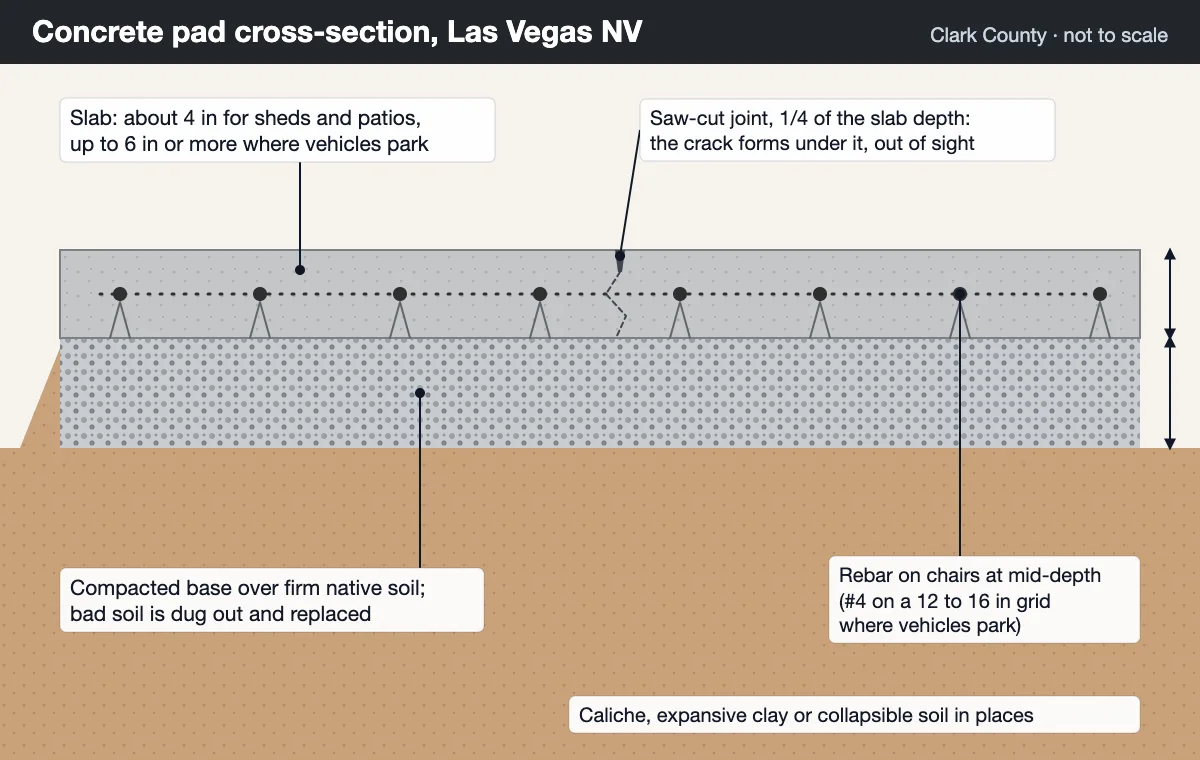
The valley's soils aren't uniform, and no public source maps them street by street. What the sources do say: caliche, a lime-cemented hardpan, runs from a few inches to several feet thick in Southern Nevada (University of Nevada Extension), and a UNLV and ASCE study calls it erratic and hard to predict, with removal being the main cost it adds. Clark County's expansive soil map grades near-surface soils from none-to-low to critical swell potential. A 2016 presentation to the Southern Nevada ICC chapter places the more severe expansive and collapsible soils mainly in the north and east valley, which is a reason not to treat a west-side Spring Valley lot as a worst case. Read caliche and concrete slabs for what breaking hardpan does to a schedule and a price.
Spring Valley slab prices, item by item
Pricing a slab starts with what goes into it. The table below breaks a typical Las Vegas area job into the parts that sources price separately, so you can see where the money goes on a Spring Valley quote.
| Item | Range | Source (date) |
|---|---|---|
| Installed slab, reinforced, per sq ft | $7 to $12 | HomeBlue Las Vegas (Sep 2024) |
| Installed slab, per sq ft | $6.11 to $12.21 | projectcosted Las Vegas (Aug 2026) |
| 3,000 psi ready-mix, per cubic yard | $143 to $150 | HomeBlue Las Vegas (Mar 2025) |
| 4,000 psi ready-mix, per cubic yard | $153 to $161 | HomeBlue Las Vegas (Mar 2025) |
| Delivery only, per truckload | $130 to $290 | HomeBlue Las Vegas (Mar 2025) |
| Breaking out an old slab, per sq ft | $1.30 to $2.10 | HomeBlue Las Vegas (Sep 2024) |
| Coverage of one cubic yard at 4 in thick | About 81 sq ft | HomeGuide, national (Feb 2026) |
Compiled from HomeBlue Las Vegas slab and per-yard pages, projectcosted and HomeGuide, read October 13, 2026. National removal guides run higher ($3 to $8 per sq ft, HomeGuide, May 2025), so get removal priced as its own line.
The per-yard numbers explain a lot. A 10x10 patio at 4 inches is a little over a cubic yard of concrete, yet it still needs a truck, a crew and a finisher, which is why HomeBlue's 10x10 figure ($1,000 to $1,700) works out higher per foot than its 20x20 figure ($4,100 to $7,000). For more on that, see slab cost by size and the main Las Vegas slab cost guide.
Spring Valley checklist
- Any vehicle parking area for the house: plan concrete or asphalt, not gravel or rock.
- Curb or sidewalk work: Clark County Public Works encroachment permit.
- Shed with a light or outlet: electrical permit, even when the shed is exempt.
- HOA lot: architectural approval before forms go in. If there's no HOA, the county rules above are the whole list.
- Contractor: a Nevada C-5 concrete license, with the license number and monetary limit printed on the bid as NAC 624.640 requires.
- Summer pour: ask how the crew handles the ACI 95 degree limit on concrete at discharge when the July normal high is 104.5.