How thick should a basketball court slab be?
A basketball court slab is residential flatwork, so the answer is the residential range: 4 to 6 inches, according to HomeBlue's Las Vegas concrete slab page, with rebar or wire mesh reinforcement common. A court carries players, a ball and maybe a hoop footing, not trucks, so it does not need driveway or RV thickness. What it does need more than a patio is flatness and good drainage, because a court that holds water or has a lip at a joint plays badly and wears fast.
Two outside requirements can raise the number. An in-ground hoop has its own footing or anchor, set by the hoop maker. A court coating system may have its own slab requirements, set by the surfacing installer. Get both before the slab is quoted. Cost per square foot rises with thickness: HomeGuide's national table lists 4-inch slabs at $6 to $8 and 6-inch at $8 to $10. The concrete slab thickness guide compares every use on this site.
Basketball court slab cost by size in Las Vegas
The slab is priced by the square foot, so the size you have room for drives the cost. Las Vegas sources from 2024 to 2026 put a plain reinforced slab at roughly $6 to $12 per square foot. The table below uses the slab sizes that sources actually publish. Pick the row closest to your court and adjust.
| Footprint | Area | Las Vegas published or computed | Concrete volume at 4 in |
|---|---|---|---|
| 20x20 | 400 sq ft | $2,442 to $4,885 (projectcosted, Aug 2026); $4,100 to $7,000 (HomeBlue, Sep 2024) | About 5 cu yd (computed) |
| 20x30 | 600 sq ft | $3,664 to $7,327 (projectcosted); $6,100 to $10,400 (HomeBlue) | About 7.4 cu yd (computed) |
| 30x30 | 900 sq ft | $9,100 to $15,700 (HomeBlue); $5,499 to $10,989 (computed, projectcosted range) | About 11 cu yd (computed) |
| 30x40 | 1,200 sq ft | $12,200 to $20,900 (HomeBlue); $7,332 to $14,652 (computed, projectcosted range) | About 15 cu yd (computed) |
Swipe the table sideways to see every column →
Sources: projectcosted.com Las Vegas concrete slab cost (August 31, 2026); HomeBlue Las Vegas concrete slab cost (September 27, 2024). Volumes are computed from HomeGuide's figure that one cubic yard covers 81 square feet of 4-inch slab, before waste. Computed prices are area times a published per-square-foot range, not published quotes. Court coatings, striping, hoops and lighting are not included.
Ready-mix itself runs $143 to $172 per cubic yard in Las Vegas depending on strength, per HomeBlue's March 2025 page, with delivery listed at $130 to $290 per truckload. The rest of the price is labor, base, reinforcement and finishing. For a full breakdown see the Las Vegas concrete slab cost guide and the cost by size guide.
What a slab quote does not include
- The acrylic or other court coating, color and line striping (a surfacing trade)
- The hoop, its mounting kit or the hoop maker's footing hardware
- Lighting and the electrical work to feed it
- Fencing or ball-stop netting
- Removing an old patio, pool deck or lawn from the footprint, unless the quote says so
How basketball courts are made
A backyard court is built in the same order whether it is a shooting pad or a full half court. These are the broad steps; the contractor you hire sets the details.
- 1Check the rules and pick the spot
Confirm HOA approval and setbacks, find where the yard drains, and choose a footprint that keeps runoff away from the house and the neighbor's wall.
- 2Excavate and grade
The crew strips rock, turf or soil from the footprint and cuts the grade so the finished court sheds water. In much of the valley this is where caliche turns up.
- 3Place and compact the base
A compacted base gives the slab even support. Soft spots and pockets of fill are dug out here rather than left under the court.
- 4Set forms and the hoop footing
Forms set the edges and the finished height. An in-ground hoop's footing or anchor is located now, following the hoop maker's instructions.
- 5Lay reinforcement
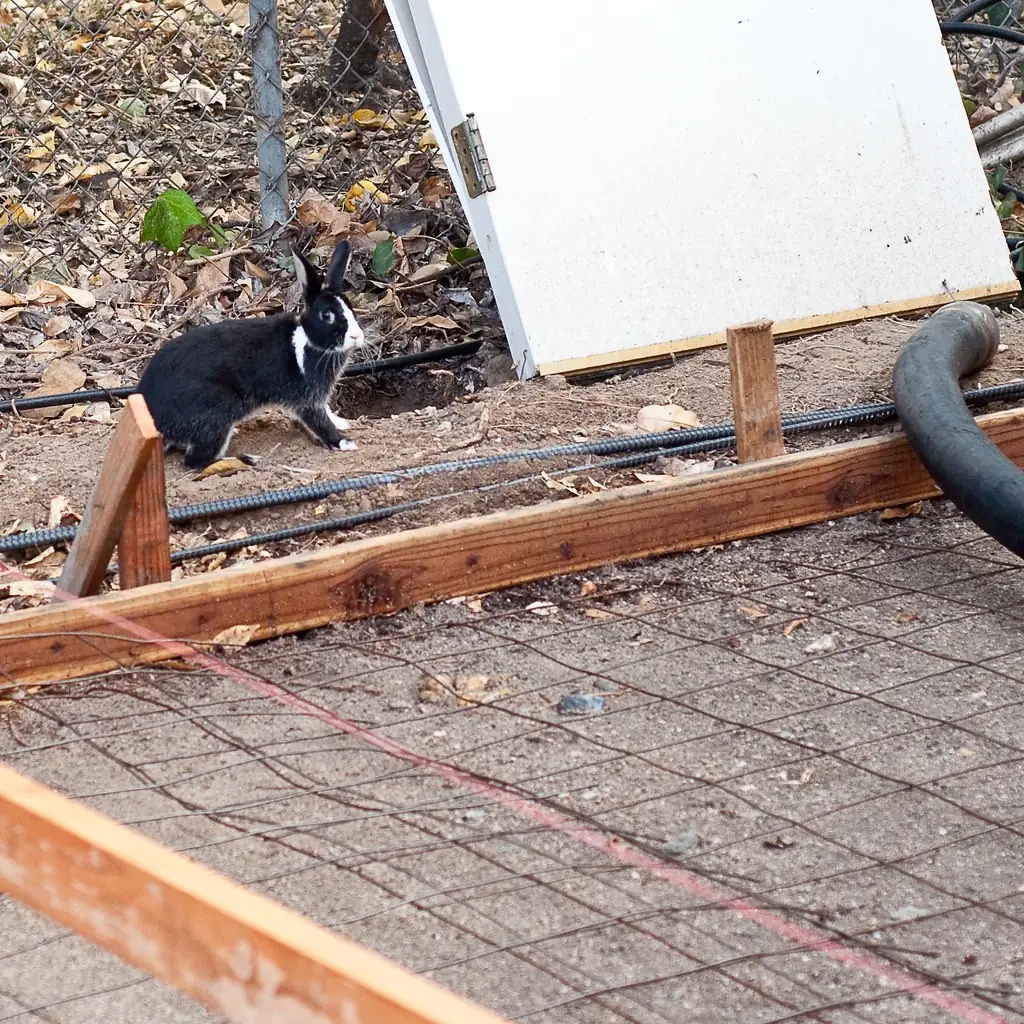
Rebar or wire mesh goes in, supported so it ends up inside the slab rather than lying on the dirt.
- 6Pour, strike off and finish
Concrete is placed, struck off flat and finished. A court that will be coated later gets the texture the surfacing installer asks for.
- 7Cut control joints and cure
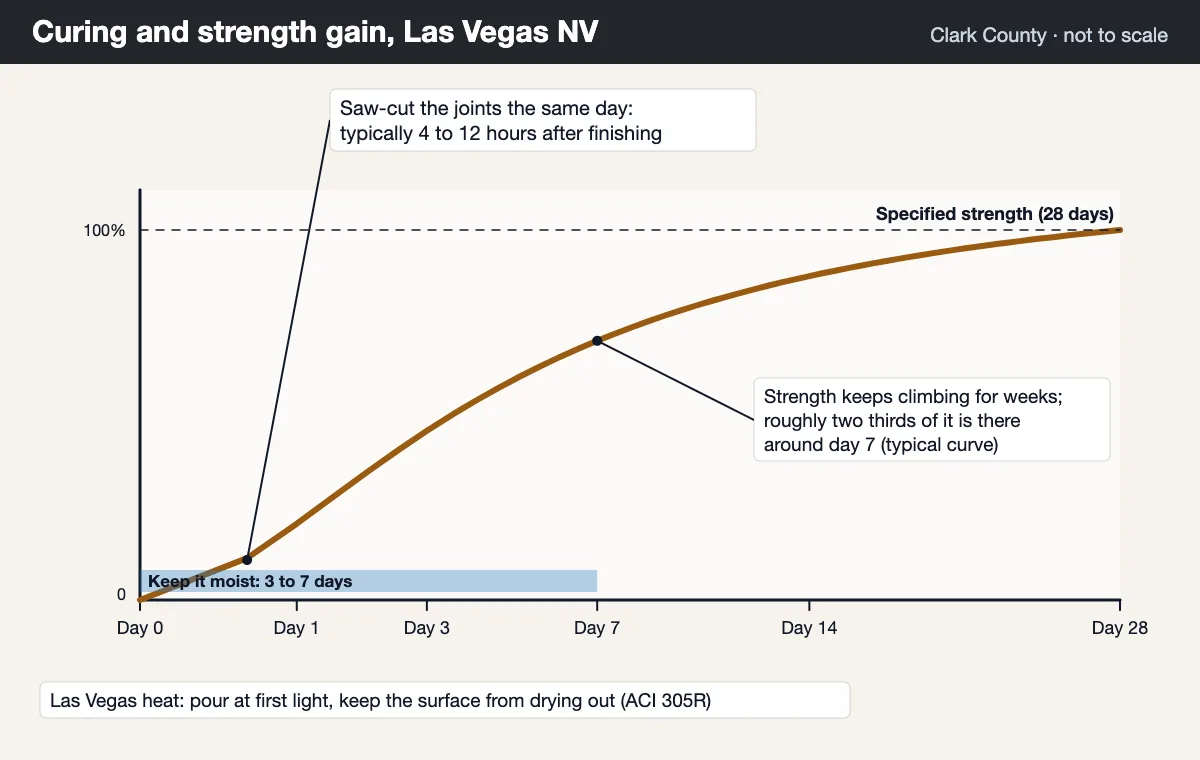
Joints are tooled or saw cut to steer cracking, and the slab is kept moist or sealed with curing compound so it does not dry out too fast in the heat.
- 8Surface, stripe and install the hoop
Court coatings, lines and the hoop come after the slab has cured. Coatings are usually a separate trade.
Drainage, joints and the finish
Make the court shed water
A court is a big impermeable surface in a yard that used to absorb rain. Las Vegas averages 4.18 inches of rain a year (NWS, 1991-2020 normals), but monsoon storms in July and August bring heavy downpours that cause flash flooding. A court slab has to send that water somewhere harmless. HOAs write this into their rules: Summerlin North's guidelines say slabs “must be installed so as not to alter the original drainage of the Lot.” The sources we use give no court slope figure, so ask how the slab will be pitched and where the water exits.
Control joints
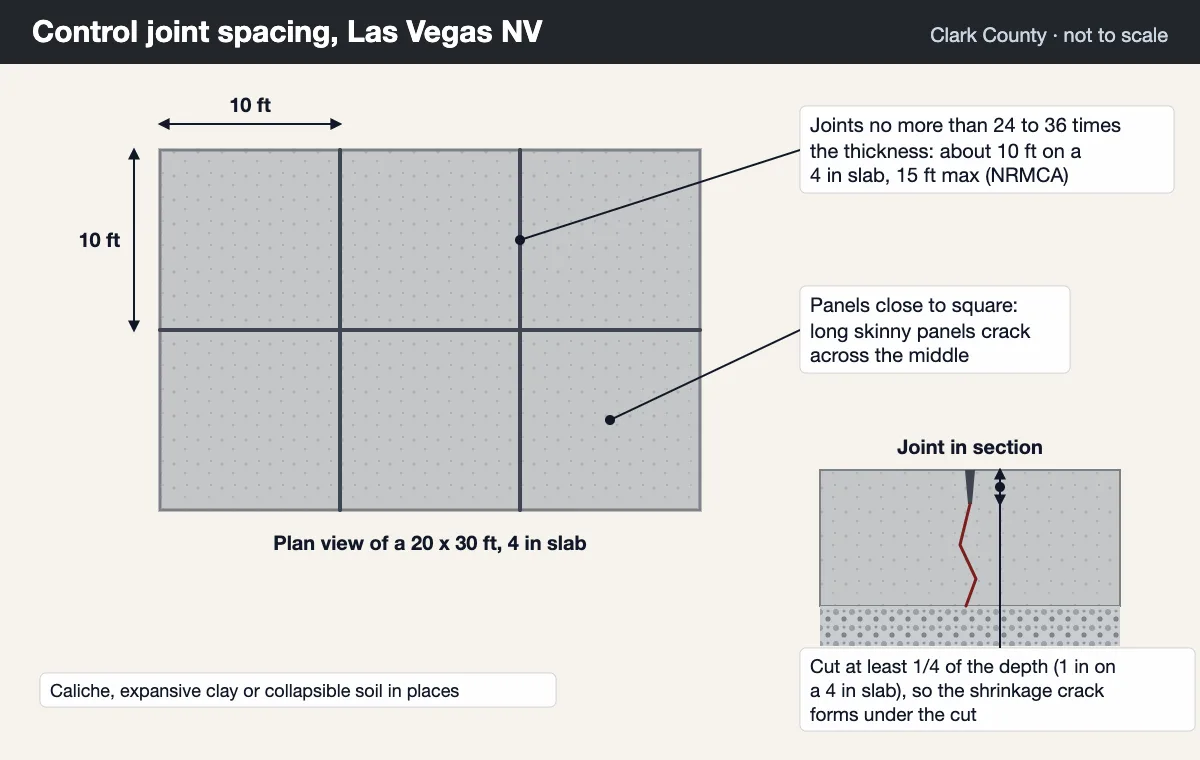
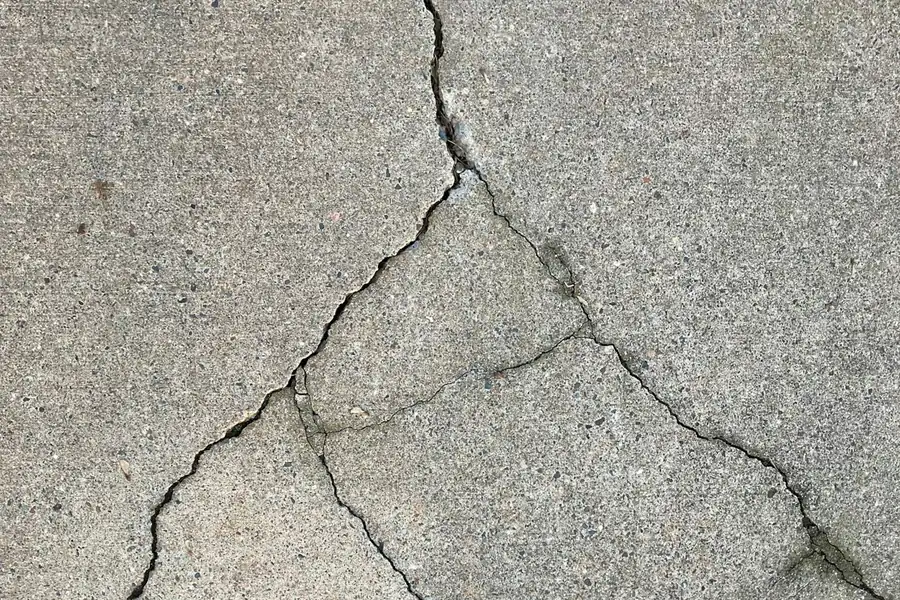
NRMCA (CIP 4) says all concrete tends to crack, and ACI (FAQ 906) calls crack-free floors unrealistic; control joints decide where. On a court, the joint layout also affects play and the coating, so talk with the surfacing installer about where joints go before the pour. See concrete slab cracks for which cracks are normal.
Finish
A court that will be coated gets whatever texture the coating installer specifies. Agree on the finish in writing with the surfacer, because it cannot be changed once the slab has set.
Rules for a backyard court in the Las Vegas Valley
A flat on-grade slab no more than 30 inches above grade is exempt from a building permit in the City of Las Vegas, unincorporated Clark County, Henderson, North Las Vegas and Boulder City. The exemption covers the slab only. It does not cover zoning setbacks, HOA approval or, in Boulder City, the “zoning review required” note on its exempt-work list. The Las Vegas concrete slab permits guide has each code's wording.
| Community | Rule |
|---|---|
| Summerlin North (Jan 2025) | Approval required for exterior improvements in front, side or rear yards, visible or not; hardscape max 60% of the front and side yard; slabs must not alter the lot's original drainage |
| Providence (May 2021) | Hardscape limited to 20% of the lot, pool decking excluded; concrete work needs a site plan with location, material and colors |
| Inspirada (Henderson) | Added concrete in the front or rear yard must be in proportion to the home and lot; colored concrete must be integral color |
| Southern Highlands (2017) | Accessory structures are reviewed and approved before construction |
From each association's published design guidelines, read 2026-10-13. Sub-associations can be stricter. Many other valley HOAs were not available to read; ask yours before you design the court.
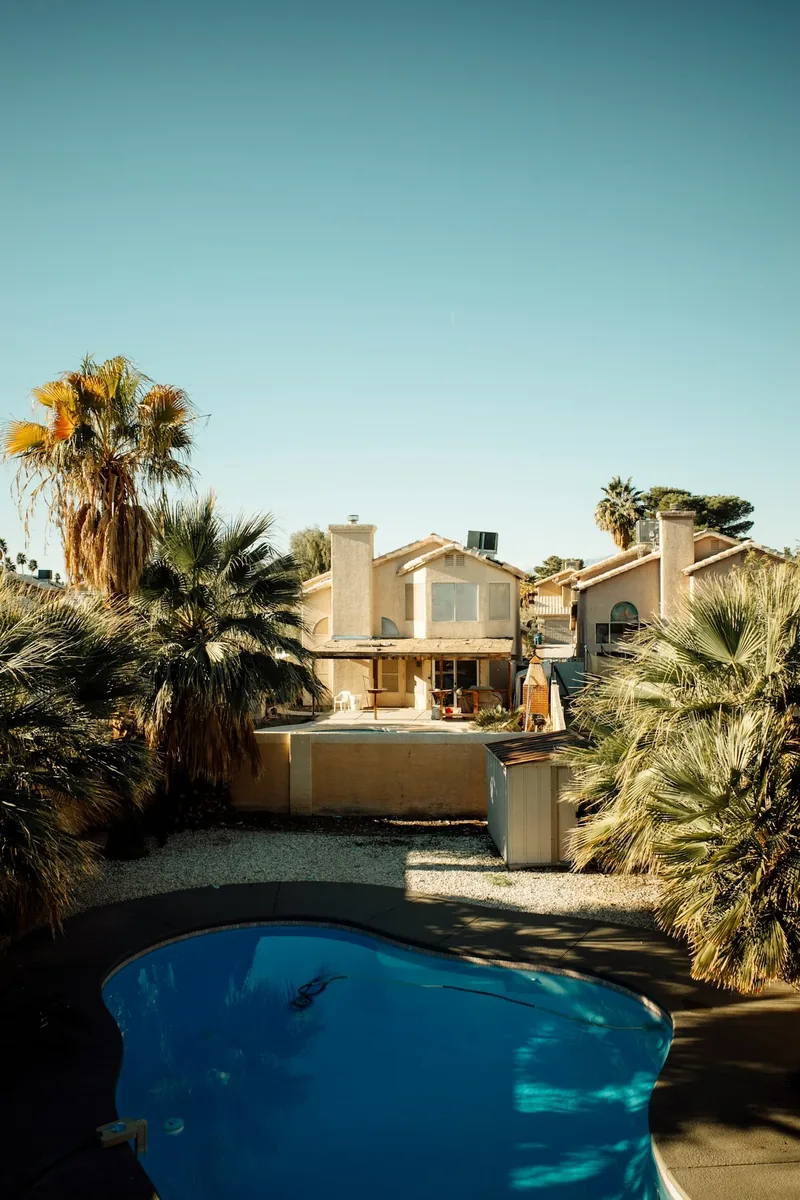
Providence's 20 percent cap is the one that bites. On a lot where the driveway, walks and patio already count toward it, a large court may not fit the allowance. Do that arithmetic before you pay for drawings.
Turning lawn into a court: the SNWA rebate catch
Replacing lawn with a concrete court does not earn the Southern Nevada Water Authority's Water Smart Landscapes rebate. SNWA's residential terms say concrete and other impermeable materials are not allowed in a conversion area and a concrete patio area is excluded. You can still convert the lawn around the court to rock and drip for the rebate, which SNWA lists at $5 per square foot for the first 10,000 square feet for residential properties, but only with approval before any grass is removed. Removing lawn first makes the conversion ineligible.
Building a court slab in Las Vegas heat and soil
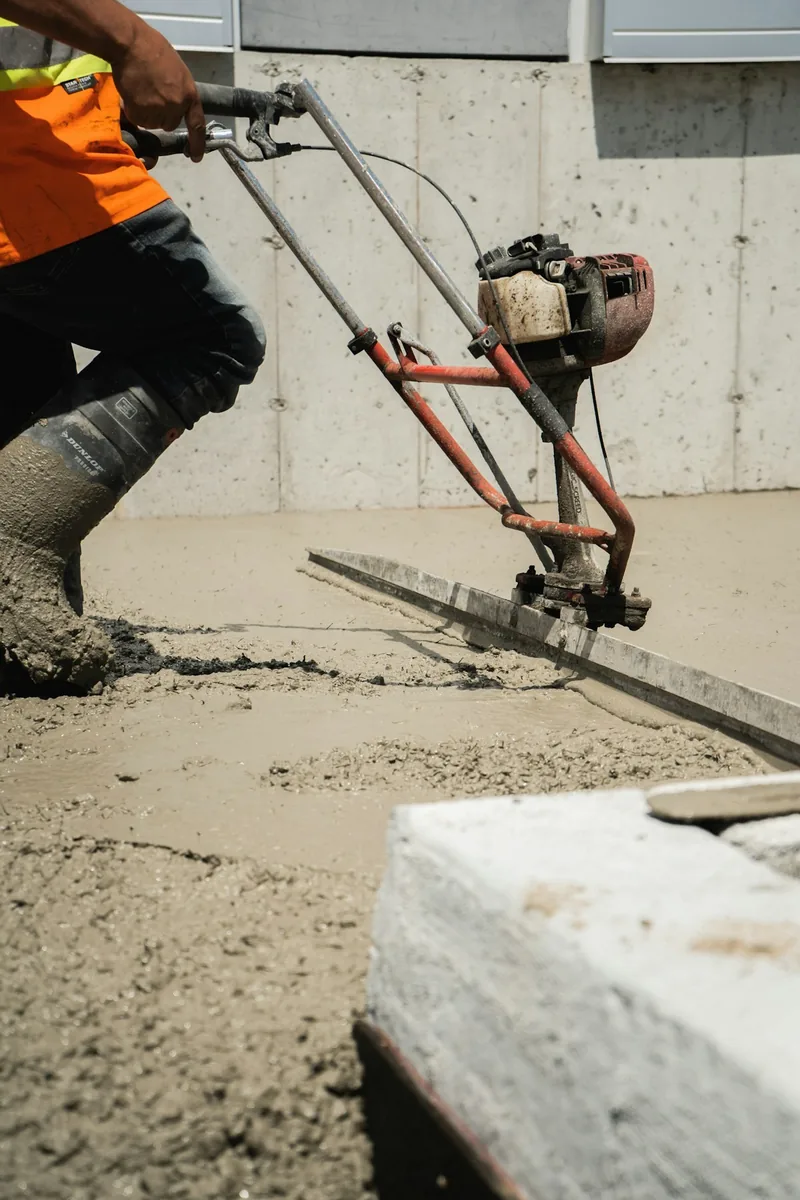
A court is one of the larger backyard pours, which makes summer harder. The airport averages 78.2 days a year at or above 100 degrees and 40.5 at or above 105 (NWS, 1991-2020 normals). ACI 301 and ACI 305.1 limit concrete to 95 degrees at discharge unless the mix is qualified for more. Big flat slabs show heat problems first, because the surface dries while the crew is still finishing it. NRMCA's hot-weather guidance (CIP 12 and CIP 5) says to avoid the hottest part of the day and favors early-morning placement. See the heat pouring guide.
Below the court, caliche is the local wildcard. University of Nevada Extension describes it as a lime-cemented layer that may be a few inches or several feet thick, and the USDA's Las Vegas soil series has it 3 to 14 inches down. A UNLV engineering paper warns that a slab resting partly on caliche and partly on softer soil can settle unevenly, which on a court shows up as a lip or a dead spot. See caliche and concrete slabs.
Taking care of a concrete court
A bare concrete court mostly needs to stay clean and dry. Sweep off rock and grit that blows in from desert landscaping, keep sprinkler overspray off it, and look at the joints each spring. A coated court follows the coating maker's care instructions. If a court is badly cracked or heaved, replacing the slab can be cheaper than trying to coat over the damage; the slab replacement page has removal costs.
Signs you are ready for a court slab quote
- Kids are shooting on the driveway and you want them out of the cars' way
- There is an unused lawn or dirt area in the back yard that your HOA would let you pave
- You have picked a hoop and have its footing instructions
- You have talked to a court surfacing installer about the coating you want
- An old patio or pad in the spot is cracked and has to come out anyway