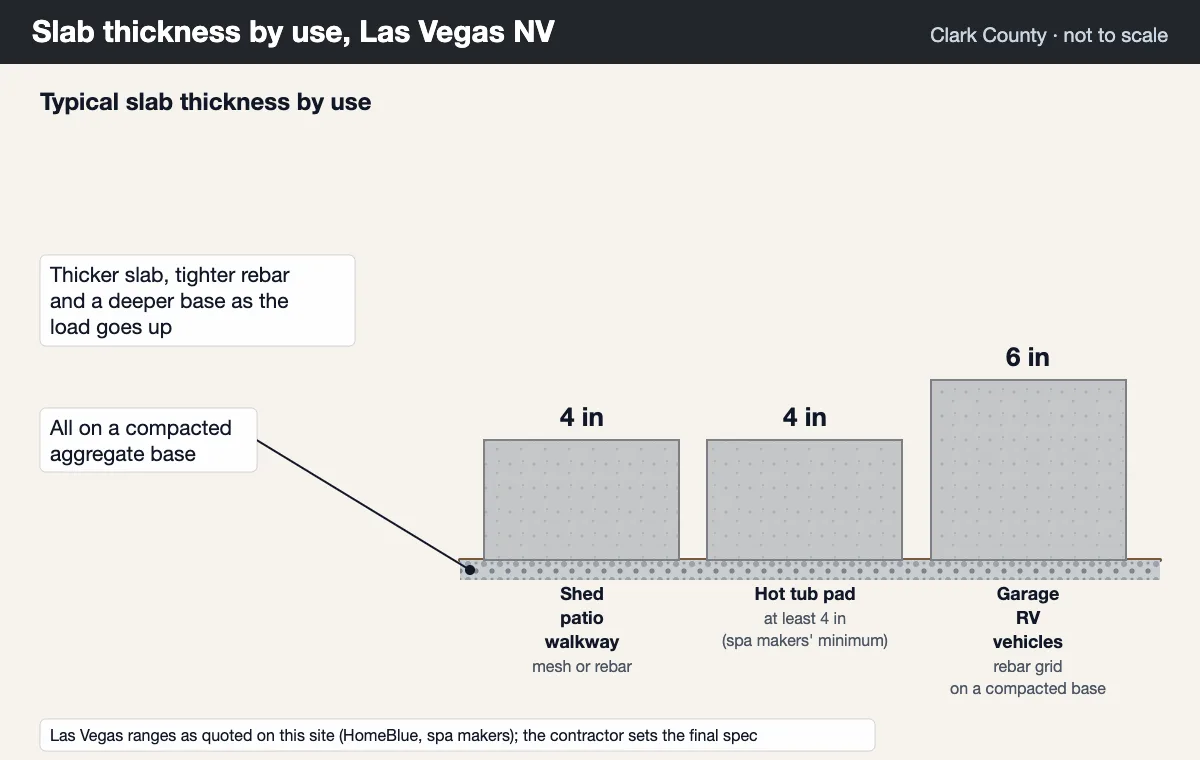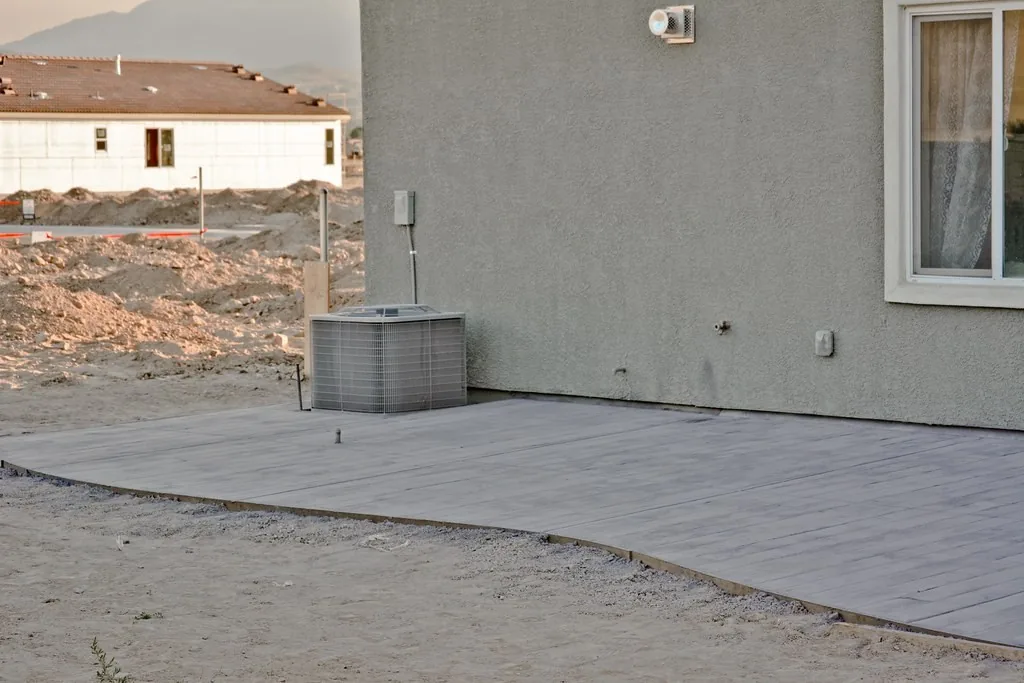
Concrete AC pads in Las Vegas, NV: the short answer
An AC pad is a small concrete slab, often just a few feet square, that holds the outdoor condenser flat and off the dirt. In Las Vegas, Nevada a poured pad costs a few hundred dollars because small jobs run on minimum charges, and it is usually exempt from a building permit as an on-grade slab. Searches for AC pad Las Vegas tend to come from three situations: a new condenser going in, an old pad that has tilted, or a pool or generator install that needs its own level base. All three are the same concrete job.
The pad is concrete work; the unit is not. Nevada's C-5 concrete license covers preparing the base, forms, reinforcement and the pour. Disconnecting, setting and wiring a condenser, pool heater or generator is HVAC, plumbing or electrical work for those trades, so most pad jobs are timed around the equipment installer.
What a small concrete pad costs in Las Vegas
Per square foot, small pads are the most expensive concrete you can buy, because the crew, the trip and the minimum order cost the same whether the pad is 9 square feet or 90. HomeBlue says its Las Vegas 3 x 3 price "includes a minimum charge," and handoff.ai's 2026 Las Vegas estimator puts small pads at $10.20 to $20.10 per sq ft against $6.70 to $12.20 for larger slabs.
| Pad size | Sq ft | Cost |
|---|---|---|
| 3 x 3 | 9 | $120 to $210 (HomeBlue, published) |
| 4 x 4 | 16 | About $163 to $322 (estimate) |
| 5 x 5 | 25 | $300 to $400 (HomeBlue, published) |
| 4 x 8 | 32 | About $326 to $643 (estimate) |
| 6 x 8 | 48 | About $490 to $965 (estimate) |
| 10 x 10 | 100 | $1,000 to $1,700 (HomeBlue, published) |
Published rows: HomeBlue Las Vegas concrete slab cost page (Sep 27, 2024). Estimate rows multiply the area by handoff.ai's Las Vegas small-pad range of $10.20 to $20.10 per sq ft (2026); they are arithmetic, not quotes. Size the pad to your own equipment.
The cheapest way to get a small pad poured is to put it on the same truck as something bigger. If you are already planning a patio slab or side yard concrete, ask for the equipment pad as a line item on that quote. For larger-slab pricing, see the concrete slab cost guide.
Concrete pad or plastic pad?
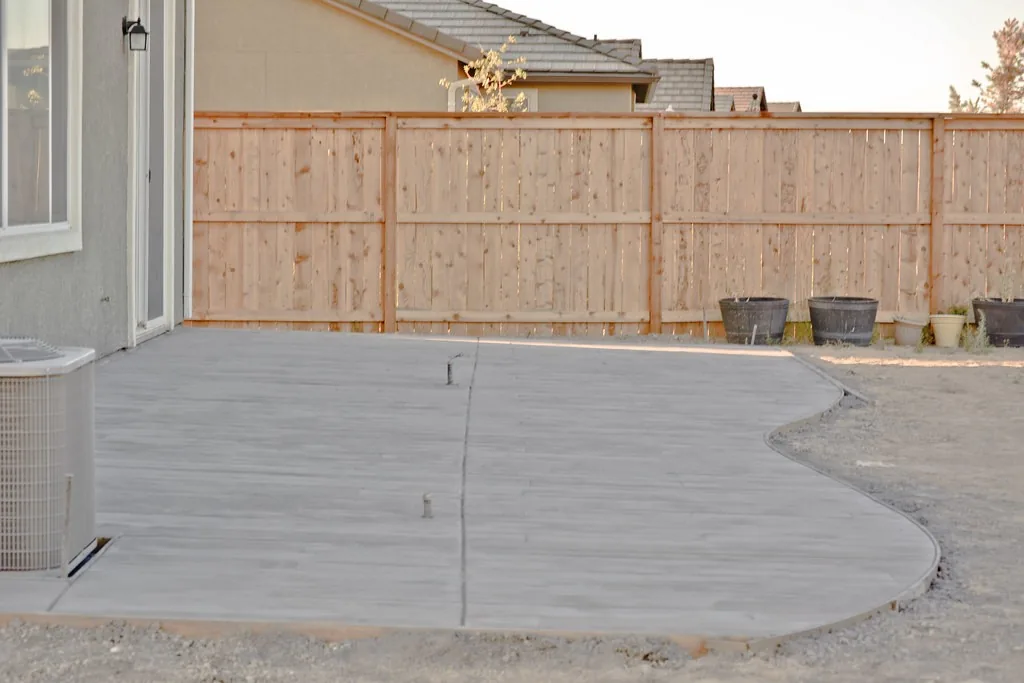
Plastic and composite condenser pads are sold off the shelf, and 36 x 36 inches is one of the most searched sizes (one 36 x 36 x 3 inch plastic pad listing ranks for this very search). They are light and quick to set, and they are only as level as the ground beneath them. A poured pad is heavier, sits on a prepared base, and can be sized to fit the unit plus service room.
| Point | Poured concrete pad | Plastic or composite pad |
|---|---|---|
| Base | Dug out, compacted, caliche dealt with | Set on whatever is there, usually leveled gravel or sand |
| Size | Any size, poured to the equipment layout | Fixed stock sizes such as 36 x 36 |
| Weight | Heavy enough to stay put | Light; can shift if the base washes out |
| Shared layouts | One slab for AC, pool equipment and generator | One pad per unit |
| Cost | Minimum charge applies, a few hundred dollars | Lower up front |
Compiled from HomeBlue Las Vegas pricing (Sep 2024) and the products ranking for 'ac pad las vegas' (Oct 2026). No Las Vegas source compares service life, so none is claimed here.
Why AC pads tilt in the Las Vegas Valley
A condenser that leans is usually telling you about the soil, not the unit. Three Valley soil conditions show up around equipment pads:
- Hydrocollapsible soils: silts, low-plasticity clays and fine sands that collapse when water is introduced, typically in the north and east of the Valley. A drip emitter, downspout or the AC's own condensate line wetting the same spot is exactly how that happens.
- Gypsum soils: near-surface 'honeycomb' gypsum, found throughout Southern Nevada, cannot support increased loads.
- Partial caliche: a pad sitting half on the cemented caliche layer and half on looser soil can settle unevenly, the indirect damage a UNLV engineering paper describes.
Those soil notes come from a 2016 geohazards presentation to the Southern Nevada chapter of the ICC and from UNLV research on Las Vegas cemented soils. The fix is the same in each case: a pad on a properly prepared base, with irrigation and drain lines routed away from it. Read more in caliche and concrete slabs.
Pool equipment pads
A pool equipment pad holds the pump, filter and heater, and often a chlorinator and control panel, which makes it longer than an AC pad. Lay it out from the equipment, not the other way round: get the pool installer's plan with the pipe runs and service space, then size the slab. Pool equipment pads sit near water by definition, which is exactly what sets off collapsible soils, so base prep and drainage away from the slab matter more here than anywhere else in the yard. Monsoon storms in July and August bring the Valley's heavy, flash-flood rain, so keep the pad above where runoff collects.
Generator pads
A standby generator needs a level, solid base, and most makers specify the pad size and clearances in the install manual. Follow that manual for spacing from the house, windows and doors. The concrete contractor pours the pad; the electrical hookup and any gas line are separate trades with their own licensing. Ask the generator installer which permits the hookup needs in your city before the pad is poured, so the pad ends up where the permitted plan puts the unit.
Permits, HOAs and where the pad can go
The pad is an on-grade slab, so it falls under the same building permit exemption as a patio: no more than 30 inches above grade and not over a basement, in all five Valley jurisdictions. Your HOA may still want to know, since several count all concrete as hardscape: Summerlin North caps hardscape at 60% of the front and side yards, and Providence at 20% of the lot. The full rule set is in the Las Vegas concrete slab permit guide.
Heat and the outdoor unit
Las Vegas averages 78.2 days a year at or above 100°F and 40.5 days at or above 105°F at the airport (NWS, 1991 to 2020 normals), and hit 120°F on July 7, 2024. Condensers work hardest exactly when a new pad is hardest to pour, and ACI caps concrete at 95°F at delivery. If the AC has died in July, NRMCA's hot-weather guidance (CIP 5) notes that early-morning placement gives better control of concrete temperature. See pouring concrete in Las Vegas heat and the curing time guide for when a pad can take weight.
Before you ask for a quote
- The equipment's base dimensions, from the spec sheet or a tape measure.
- The clearances the install manual asks for around the unit.
- Whether the old pad needs to be broken out and hauled away first.
- Who is disconnecting and resetting the equipment, and when.
- Any irrigation or drain lines near the spot that should be moved.
Checking the contractor on an equipment pad
In Nevada the contractor's license number belongs on the bid by law; check it on the NSCB license search. Other small slabs that often go with an equipment pad: a hot tub pad or a shed slab. Browse concrete slabs in Las Vegas, see the service area page, or request a quote.